Table of Contents
What is DNA?
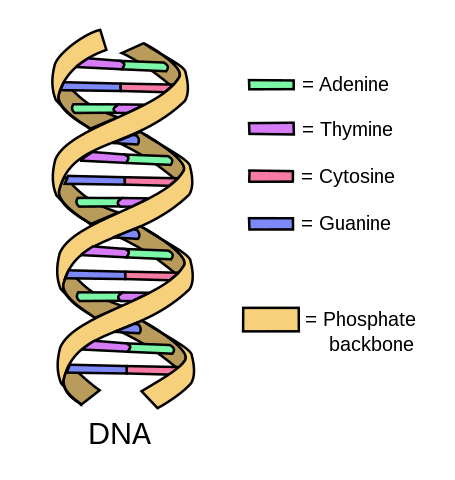
DNA, or deoxyribonucleic acid, is a long chain of molecules that dictates the functions of a cell. The molecules that make up DNA are called nucleotides. A nucleotide includes one of four bases: adenine (A), guanine (G), thymine (T), and cytosine (C). Nucleotides with complementary bases pair with each other to form base pairs. Base pairs are formed between adenine and thymine, and guanine and cytosine. The structure of DNA resembles that of a zipper, and the nucleotides form the teeth of the zipper. When they form base pairs, it is as if the zipper is closed. The support system, or backbone, of DNA is made up of sugar and phosphate.

DNA is like one long sentence that acts as a set of instructions the body needs to follow to perform its functions correctly. These instructions are contained in segments of DNA called genes. Genes form the structural and functional units of inheritance.
How is DNA passed on from the parents to the baby?
The ovum, or egg cell, of the mother, and the sperm cell of the father are called gametes. They contain the genetic information of the mother and father respectively. A baby is formed when an ovum fuses with a sperm. This process of fusion is called fertilization. Fertilization produces a zygote. The zygote contains approximately half the DNA of the ovum and half the DNA of the sperm. Thus, a baby is nearly half its mother and half its father.

The zygote divides rapidly to form an embryo. The embryo is made up of many cells, and all the cells have the same DNA. The DNA gives the cells instructions on how to further differentiate and take up different functions. With time, the cells divide more and more to form different types of cells, tissues, and organs. Over the next nine months, the baby develops.
How are twins born?
In general, one ovum and one sperm fuse to form one zygote that divides to form one baby. But sometimes, the mother releases two ova or eggs, that are fertilized by two sperm cells. Each of these ova are fertilized and develop into two babies. These babies are known as non-identical twins or fraternal twins. Since the process of fertilization forms two zygotes in this case, the babies are also called dizygotic (“di” means two). Since two different sperm cells fertilize the ova, non-identical twins can be of different genders.
In other cases, the fertilized zygote can split into two embryos. Each embryo develops into a baby. Since a single zygote forms both babies, such twins are called identical or monozygotic (“mono” means one) twins. Identical twins are almost always of the same gender, simply because a single sperm fertilizes the ovum.

Do twins share the same DNA?
In the case of non-identical twins, each baby shares about as much DNA as any siblings would. This is because each baby is born from the fertilization of a different egg with a different sperm. even though all the eggs have the same DNA and all the sperm cells have the same DNA, zygotes formed by their fusion will not be genetically identical. This is because of a process known as recombination.
Recombination is the breaking, exchange, and re-joining of two different DNA molecules. This process is what makes babies genetically similar to their parents. Recombination does not follow a common pattern, so the DNA in each zygote is different. This is why non-identical twins do not look the same despite sharing some common features, much like regular siblings.
On the other hand, people assume that identical twins have the exact same DNA because they look almost exactly the same. But this is untrue. Despite being born from the same zygote, the DNA of identical twins is not 100% identical. This is because human DNA contains nearly 3 billion base pairs. These base pairs are prone to mutations that are caused by various physical and chemical factors. While most of these mutations are repaired by repair mechanisms in the body, many go unrepaired. These unrepaired mutations cause differences in the DNA of identical twins.
Why do identical twins have different DNA?
The degree of similarity between the genetic makeup of identical twins depends on the time at which the zygote splits into two cells. In a one-baby pregnancy, around three days after conception the zygote divides into two cells. Both these cells remain connected. In twins, these cells split from each other and develop independently. This is called the 3-day separation. Twins born by this way are genetically most dissimilar.
Sometimes, the zygote does not split till day five after conception. By this time, more cells will have formed. The splitting of the zygote on day five is called 5-day separation. In this case, the babies are called mirror-image twins. Their similarities are on opposite sides, like looking into a mirror. These twins have a lower degree of differences in their DNA.
Twins with the least number of differences in their DNA are formed from a 9-day separation. They are also called mirror-image twins. Any splits taking place after day 10 are more likely to form conjoined twins.
Recent studies showed that the DNA of identical twins varied at certain regions of the genome. At these points, each twin had an unequal number of copies of the same gene. This deviates from the normal state in which each person carries two copies of a gene, one inherited from each parent.
Other factors that cause identical twins to be different can be differences in nutrition they receive in the womb. Sometimes some traits get suppressed in the womb, which also causes identical twins to have different features.
Conclusion
Understanding the genetic differences between identical twins has led to a better understanding of diseases and their causes. In some situations, it has also helped solve criminal cases where the accused was an identical twin. Moreover, identical twins become less and less identical as they grow older, because of environmental factors that cause changes in their DNA, and also changes in lifestyle. Scientists have suggested changing the name from “identical twins” to “one-egg twins.”
Glossary
Conception: The joining of the egg and the sperm
Embryo: Early developmental stage in animals and plants
Genome: All of the genetic material in an organism
Mutation: A change in the DNA sequence
Conjoined twins: A rare situation in which two babies are born physically connected to each other
Flesch Kincaid Grade Level: 7.4
Flesch Kincaid Reading Ease: 65.4
References
(no date) Genetics Awareness Project. Available at: http://gap.med.miami.edu/learn-about-genetics/have-questions-about-genetics/are-identical-twins-100-genetically-identical (Accessed: December 25, 2022).
Casselman, A. (2008) Identical twins’ genes are not identical, Scientific American. Scientific American. Available at: https://www.scientificamerican.com/article/identical-twins-genes-are-not-identical/ (Accessed: December 25, 2022).
How are genes passed on? – informedhealth.org – NCBI bookshelf (no date). Available at: https://www.ncbi.nlm.nih.gov/books/NBK541156/ (Accessed: December 25, 2022).
Identical twins carry genetic modifications no one else has (no date). Available at: https://www.science.org/content/article/identical-twins-carry-genetic-modifications-no-one-else-has (Accessed: December 25, 2022).
Lanese, N. (2022) Identical twins don’t share 100% of their DNA, LiveScience. Purch. Available at: https://www.livescience.com/identical-twins-dont-share-all-dna.html (Accessed: December 25, 2022).
Person (2021) Do identical twins have the same DNA? research says not quite, Healthline. Healthline Media. Available at: https://www.healthline.com/health/do-identical-twins-have-the-same-dna#different-traits (Accessed: December 25, 2022).
Villazon, L. (2020) Do identical twins have identical genes?, BBC Science Focus Magazine. BBC Science Focus Magazine. Available at: https://www.sciencefocus.com/the-human-body/do-identical-twins-have-identical-genes/ (Accessed: December 25, 2022).
Zapata, K. (2020) What are Mirror Twins? here’s everything you want to know, Healthline. Healthline Media. Available at: https://www.healthline.com/health/pregnancy/mirror-twins#definition (Accessed: December 25, 2022).
Contributors
-
Sanjana Kadur: AuthorView all posts
Sanjana is doing her masters in biochemistry. She loves all things biology and truly believes that dogs make the world a better place. She enjoys playing basketball and spends most of her evenings on the court. Writing for Smore Science gives her the creative freedom to write about science in a fun and relatable way.
Copyright @smorescience. All rights reserved. Do not copy, cite, publish, or distribute this content without permission.
SUBSCRIBE TO OUR NEWSLETTER
.......... ..........Subscribe to our mailing list to get updates to your email inbox.
Monthly Newsletter