In 1913, Teddy Roosevelt went on a Brazilian expedition, and over-enthusiastic tour guides tried to impress him by painting piranha as man-eaters. During his statements on the trip, such as, “Piranhas are the most ferocious fish in the world..” the President inadvertently tagged piranhas with the question, ‘Do piranhas eat humans’ and for well over a century, these animals have been unable to shackle this slur.
Here, we investigate and discuss with scientific evidence that piranhas are not compulsive man-eaters. In fact, they ignore humans unless deliberately provoked.
To the earlier question: Do piranhas eat humans? Dr. Herbert Axelrod answered this query by entering a pool containing aggressive red-bellied piranhas. He was unhurt without a single bite, proving that piranhas intentionally do not hurt humans.
Research shows that most piranha bites occur on the feet and hands and are more accidental than predatory. The idea of a swarm of piranhas skeletonizing a large animal or a human in minutes is more fiction than fact.
Piranha’s foreboding teeth
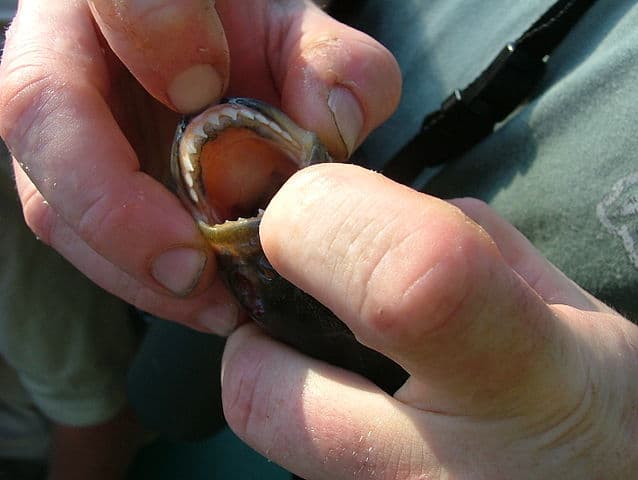
Piranhas means ‘toothfish’ and is named for their razor-sharp and interlocking teeth. They can bite with a force of 72 pounds, but that doesn’t mean they maul anyone who trails hands in their habitat.
A fascinating feature is that unlike sharks, which can replace a single worn-out tooth, piranhas lose all teeth on one side of their mouth at once and regrow them several times during their life span. This is because the teeth are interlocked on each side, and hence, when one tooth wears out, they have to replace an entire set.
The Diet of a Piranha: Meat, Myths, and More
Contrary to their image, piranhas are omnivores, many feeding on plant material.
Their diet mainly consists of fish, insects, and plant material. Most piranha species prefer scavenging to hunting large prey, including humans.
Understanding piranha behavior: More than meets the eye
Piranhas exhibit fascinating behaviors often overshadowed by their fierce reputation. For instance, they communicate using sounds and are known to exhibit schooling behavior, which is more about protection and social interaction than hunting in packs.
In their natural habitat, piranhas play a crucial role in the ecosystem. As scavengers, they help keep their environment clean by feeding on dead and dying animals.
While piranhas can be dangerous under certain conditions, the widespread belief that they are man-eaters is a myth. Understanding the truth about these fascinating fish helps us appreciate the diversity of life in our waterways and the importance of preserving their population.
South American River Ecosystem with Piranhas, Credit: Wikimedia/Tiia Monto
Glossary
Omnivores: Animals that eat both plants and meat.
Scavengers: Animals that feed on dead or decaying organic matter.
Ecosystem: A biological community of interacting organisms and their physical environment.
Schooling Behavior: The behavior of fish swimming in a coordinated manner in groups.
Roosevelt, T. 1914. Through the Brazilian Wilderness, with Illustrations By Kermit Roosevelt and Other Members of the Expedition. New York: Scribner’s.