Octopus are the elusive, flexible and boneless wonders of nature. They are also the Houdinis of the marine world. Their fluid movements allow them to fit through the smallest of holes while their vibrant colors, and unique shape make them an incredible sight to behold. How does this creature function without any bones in its body to give it structure and support? Lets dive into the incredible anatomy and its ingenious adaptations that allow them to thrive in the underwater world.
Understanding Cephalopods
Before we dive into the specifics of their boneless anatomy, we need to know the group of animals in which an octopus belongs. Grouped under cephalopods , the term is derived from the Greek words for head and foot, which pretty much sums up the shape of an octopus: a bulbous head and numerous feet, or as we more commonly refer to them, arms.
Their tentacles, usually eight in total, are equipped with suckers, which the octopus uses for a variety of tasks such as capturing prey, exploring its environment, and defending against predators. It’s quite an extraordinary creature, to say the least.
Octopus Vulgaris, Credit: Wikimedia/Daiju Azuma
Structure and composition of octopus skeletons
As humans, we rely on our skeleton – an internal structure made of bones – to provide support to our body, protect our vital organs, and facilitate movement. But how does an octopus, a creature with no bones, accomplish these necessary tasks?
The answer lies in a special type of structure known as a ‘ hydrostatic skeleton ‘. Instead of bones, the octopus has this unique system made of muscles and water-filled cavities. It operates a bit like a water balloon: when pressure is applied to one area, the water shifts, causing another area to expand. The octopus uses this system to manipulate its body shape and movement.
The hydrostatic skeleton gives the octopus a surprising amount of control over its form. By adjusting the water pressure in different parts of its body, an octopus can lengthen or shorten its arms, flatten its body, or even mimic the shape of other objects or animals.
Something similar is found in starfish too, which cycles and transports nutrients in them, much like blood in case of humans. It is known as the ambulacral system.
Octopus Diagram, Credit: Wikimedia/Michael Vecchione, Clyde F.E. Roper, & Michael J. Sweeney
Octopuses as masters of camouflage and escape
Without a rigid skeleton, you might imagine that an octopus would be limited in its capabilities. But in reality, the opposite is true. Their lack of bones provides them with a level of flexibility and adaptability that is nothing short of extraordinary. Here’s a proof.
For starters, octopuses can fit through any opening larger than their beak, the only hard part of their body. This ability to squeeze through tiny cracks and crevices allows them to escape predators and venture into places other marine animals cannot reach. It’s like being a master locksmith with the ability to unlock and slip through the tightest doors!
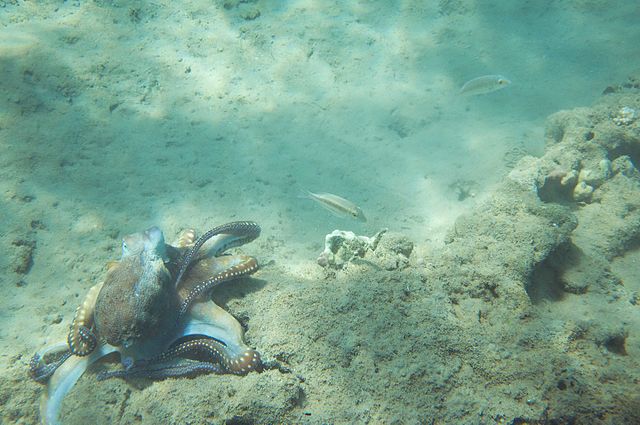
Moreover, the lack of bones contributes to the octopus’s renowned ability to camouflage itself. An octopus can not only change the color of its skin to match its surroundings but also alter its texture and shape. It can mimic the roughness of a rock or the smoothness of sand. This adaptability makes it a master of disguise, able to evade detection by both predators and prey.
If an octopus happens to lose one of its limbs due to predation or injury, it possesses the remarkable ability to regenerate it.
The process is called autotomy, which triggers specialized cells called blastemal cells, which kick-start the regeneration process. The blastemal cells rapidly multiply and transform into different tissues needed to rebuild the lost limb. Understanding the exact mechanism of how this works could help scientists begin to learn how to apply it to human tissue and organ regeneration.
Anatomical variations in octopus skeletons
Even though all octopuses lack bones, they vary anatomically amongst themselves. This can be seen in their external appearances, internal structures, and their reproductive systems.
Some octopus species have an internal shell called a gladius or pen, made of chitin, which supports and rigidifies their bodies. This structure, akin to exoskeletons in insects and crustaceans, resides within the mantle, providing a streamlined shape for efficient swimming.
Male octopuses display diversity in reproductive organs. Specific species possess a specialized arm called a hectocotylus, derived from one of their eight regular arms. This unique arm transfers sperm precisely to the female during mating, showcasing the intricate reproductive strategies in the octopus family.
These examples emphasize the octopus family’s remarkable variety. Despite lacking bones, octopuses have evolved diverse adaptations, tailored to their ecological niches and reproductive needs.
Wonders of octopus skeletons
Living without bones may seem like an alien concept to us, but for octopuses, it is simply a way of life. Far from being a limitation, their boneless bodies provide them with a suite of advantages that are integral to their survival in the diverse and challenging marine environment.
An animal so flexible that it can squeeze through the smallest holes, is certainly cool. They might as well be the Mr. Fantastic or Elastigirl of the marine world. Yet again, nature surprises us with neat tricks.
Glossary
Cephalopods: A type of marine animal that includes octopuses, squid, and cuttlefish. The term comes from the Greek words for ‘head’ and ‘foot’.
Hydrostatic Skeleton: A structure found in many soft-bodied animals that allows them to move by using water pressure within their bodies.
Camouflage: The ability of an animal to change its coloration or patterns to match its surroundings, helping it hide from predators or prey.