The process of digestion is how our bodies break down food into smaller pieces that can be absorbed and used. Have you ever thought about where digestion starts? Some people might say it begins in the mouth, while others might say it begins in the stomach.
Digestion is a process that most living things go through. Almost all living things, from the smallest bacteria to the biggest mammals, need to break down food to get the nutrients they need to work properly. What makes us different is where digestion starts. In this article, we’ll talk about where digestion starts in humans and other animals.
Digestion in Humans
For humans, digestion begins in the mouth. The mouth is in charge of mechanically breaking food down into smaller pieces that are easier to digest. When we chew our food, we use our teeth to break it up into smaller pieces. This makes it easier for the enzymes in our stomachs to do their job.
But how do these enzymes do what they do? Enzymes like amylase in our mouths helps break down the carbohydrates in the food we eat. This enzyme starts to break down carbs into simpler sugars, like glucose, that are easy for our bodies to absorb.
The food goes down the esophagus and into the stomach as we swallow it. Here, the process of digestion keeps going. The stomach is a muscular sac that churns food around and mixes it with digestive juices that break it down more. The digestive juices are called gastric juices. It is a mix of enzymes, like trypsin and pepsin, and hydrochloric acid. Stomach acid is important for digestion because it creates an acidic environment so that trypsin and pepsin can break down proteins and large molecules more easily. Trypsin and pepsin are inert when released. The acid in the stomach activates them.
Then food travels to the small intestine, where fats are digested. The digested nutrients are absorbed as the unusable parts of digested food travel further down into the large intestine. These portions form the roughage. It consists of fibers that we cannot digest. Good roughage allows easy passage of feces.
But humans are not the only living things that digest food. There are many organisms, like bacteria and fungi, that digest food outside of their bodies by releasing enzymes or acids. This process is known as external digestion.
What is External Digestion?
External digestion is the process by which enzymes and acids are used to break down food outside of the body. In this process, the organism releases enzymes or acids onto the food matter, which then starts to break down. Once the food is broken down, it is then absorbed by the organism. This process is in contrast to internal digestion, which is the process of breaking down food inside the body.
External digestion is used by bacteria, fungi, and animals, among other things. Some animals, like sea stars, spiders, and some insects like beetles and termites, digest their food outside of their bodies.
How Does External Digestion Work?
When an organism puts digestive enzymes or acids on food, this is the first step in the process of external digestion. The enzymes or acids then start to break down the food matter by breaking down large molecules into smaller molecules that the organism can absorb. The enzymes do their job by breaking the chemical bonds that hold food molecules together.
Once the food is broken down, the organism can then absorb the nutrients. In some cases, the organism will ingest the food matter, which then passes through its digestive system. In other cases, the organism will take in the nutrients directly through its skin.
Think about the spider as an example. Spiders paralyze their prey with venom, and then they let out digestive enzymes that break down the tissues of their prey. The spider then eats the food that has been broken down. Spiders aren’t the only animals that digest their food outside of their bodies. Snails, worms, and even some fish do the same thing.
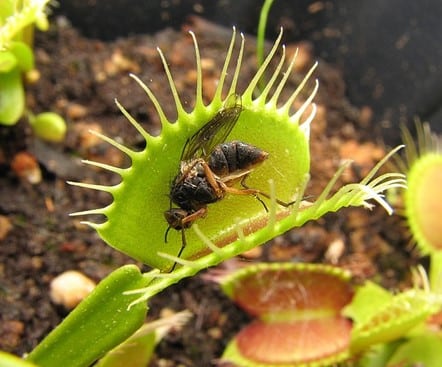
Muscoid fly trapped by a Venus flytrap. Credit: Wikimedia Commons/Beatriz Moisset
Another fascinating example of digestion is seen in the carnivorous plant known as the Venus flytrap. This plant, native to the southeastern United States, has leaves with trigger hairs that snap shut to capture insects. Once an insect is captured, the plant releases enzymes that begin to break down the insect’s exoskeleton , followed by the digestion of the insect’s soft tissue. The plant then absorbs the nutrients from the insect to use in its own growth.
Some animals have evolved interesting ways to digest their food that allow them to extract nutrients from foods that would be indigestible to other animals. For example, termites are known for their ability to digest wood. These insects have evolved a special digestive system that involves a symbiotic relationship with microorganisms in their gut. The microorganisms break down the cellulose in wood, making it easier for the termites to digest and extract nutrients from it. This ability has allowed termites to become successful in their ecological environment as decomposers and builders of large termite mounds.
Another animal with a unique method of digestion is the cow. Cows are known for their ability to extract nutrients from plants through a four-chambered stomach system. Let us try to understand how cows are different from humans.
Rumination
In animals like cows and sheep, the digestive process starts in a unique place: the rumen. The rumen is a large fermentation chamber in the stomach, and it houses bacteria that break down the complex carbohydrates found in grass and other plant materials. These bacteria produce enzymes that can break down cellulose, a complex carbohydrate found in plants that humans cannot digest. This process of digestion is essential to these animals because it allows them to access the nutrients found in tough plants.
In conclusion, digestion is a vital process that happens in almost all living organisms. While humans begin the process of digestion in the mouth, some organisms release enzymes or acids to digest food matter outside the body. Understanding where digestion begins is an essential first step to understanding the digestive process and how it is done by different living organisms.
Glossary
Enzymes – Proteins that speed up chemical reactions in the body.
Amylase – An enzyme that breaks down carbohydrates into smaller sugars like glucose and fructose.
Esophagus – The muscular tube that connects the mouth to the stomach.
Exoskeleton – A hard external skeleton, found in many invertebrate animals, that protects and supports the body.
Symbiotic relationship – A relationship between two different species of organisms that live together in close association, often to the mutual benefit of both organisms.
Fermentation – The process by which organic substances, such as carbohydrates, are broken down by microorganisms into simpler compounds, such as acids, gases, or alcohol, in the absence of oxygen.
Carbohydrates – a type of organic compound including sugars, starches, and cellulose.
Cellulose – a complex carbohydrate found in plants that is tough and difficult to digest.