Table of Contents
Most of us dream about swimming in the crystal clear waters of the Maldives or Bermuda, yet over 90 percent of the water in the world is pretty much the opposite. Bodies of water are notoriously hard to see through, from rivers filled with sand and sediment to oceans filled with murky waters.

Think about it: in even the clearest of waters, it’s pretty hard to accurately judge where exactly things are. For instance, throwing a coin into a pool takes us quite a while to do with precision. This is because light doesn’t travel through water the same way it does with air.
How does light travel through water?
Light doesn’t just dive straight through water, rather, it bends and continuously keeps changing direction. Interestingly enough, not all waters even receive light!

What Does This Mean?
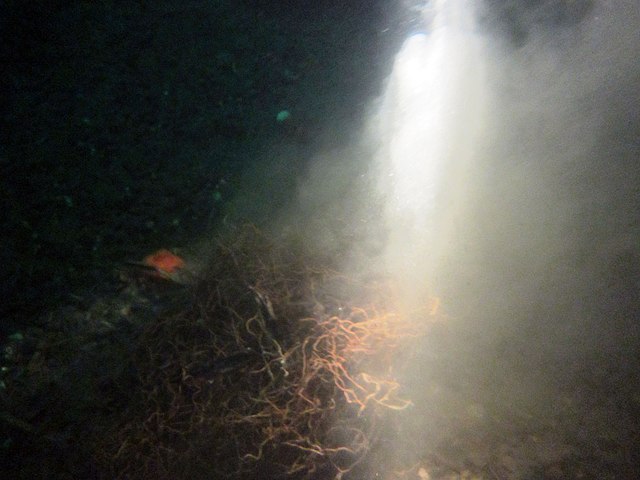
As the depth of water increases, the amount of light that it receives decreases in turn. For instance, think of the deepest point in the world, the Mariana Trench. The trench famously forms the benthic boundary layer of the water column. Essentially, beyond this point, it’s all just sediment or sea bed. It’s a region bathed in darkness because it literally receives little or zero sunlight!
No light but plenty of fish
Weirdly enough, the loss of light doesn’t equate to a loss of life. In benthic regions like the Mariana Trench, life still goes on. From flatfish to cartilaginous species like rays and skates, the benthic zone of the water column still teems with life.
A High-Pressure Situation
Funnily enough, a fish’s sight has less to do with its eyes than you’d expect. As the depth of water increases and the amount of light that it receives also decreases, meanwhile pressure increases! So, light becomes a tricky thing to follow, whereas pressure on the other hand will always reliably increase. In fact, as depth increases, fishes don’t just depend less on light; some even chose to lose their sight completely!
The Curious Case of Cave Fish
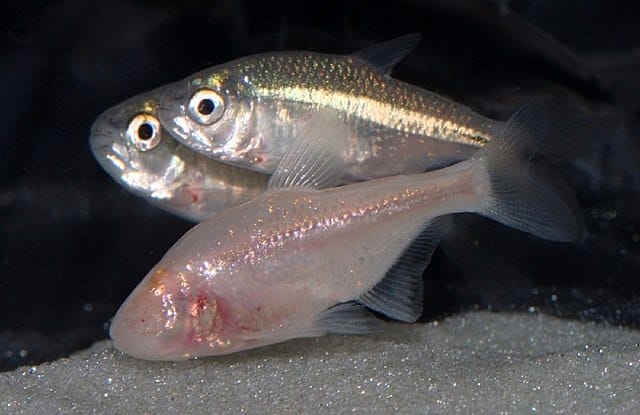
As the name suggests, cave fish do in fact live in caves, but that’s not the most interesting part. What’s interesting about these fish is that they no longer have any eyes. What’s interesting about these fish is that they no longer have any eyes. There are spider species that lack eyes too. As the tale goes, these fish decided to trade in the functionality of their eyes for pressure-sensitive organs that run along the lateral line of their bodies.
(Fun Fact: These fish are a great example of regressive evolution and a great reminder that evolution is a non-directional process!)

How do these pressure-sensitive organs help the fish?
Fishes adjusted to deep and light-less waters, such as the Mexican Cave Fish, have pressure-sensitive organs as opposed to functional eyes. These organs detect changes in the surrounding water pressure. These organs contain cells known as hair cells that detect surrounding stimuli (like a change in water pressure when they swim up or down the water column, or the changes in water pressure caused by the movement of surrounding fish or organisms) and then form “mind-maps” of information that the fish can use to navigate the waters.
Conclusion
Not all fish are benthic. Fish that live relatively higher up in the water column have special cells, called rod cells, in their eyes that help them see better in medium or low-light waters. For example, if a fish swims from a bright light to a low light environment, the eye of the fish will gradually increase the activity of rod cells in it to compensate for the impending darkness.
Readability: 64.6
Flesch Kincaid Grade Level: 8
Glossary
Benthic: Describes any organism or geographical location that occurs on the bottom of a given water body.
Cartilage: A type of flexible connective tissue that gives structure.
Stimuli: Changes or occurrences in a surrounding environment (internal or external) that can elicit a bodily response.
References
Owen, J. (2021, May 3). How This Cave-Dwelling Fish Lost Its Eyes to Evolution. Animals. https://www.nationalgeographic.com/animals/article/150911-blind-cavefish-animals-science-vision-evolution
Villazon, L. (2020). Can fish see in the dark? BBC Science Focus Magazine. https://www.sciencefocus.com/nature/can-fish-see-in-the-dark/
Davis, V.A., Holbrook, R.I. & de Perera, T.B. Fish can use hydrostatic pressure to determine their absolute depth. Commun Biol 4, 1208 (2021). https://doi.org/10.1038/s42003-021-02749-z
Contributors
Copyright @smorescience. All rights reserved. Do not copy, cite, publish, or distribute this content without permission.
SUBSCRIBE TO OUR NEWSLETTER
.......... ..........Subscribe to our mailing list to get updates to your email inbox.
Monthly Newsletter