Are Lionfish Poisonous?

Table of Contents

Lionfish – An Introduction

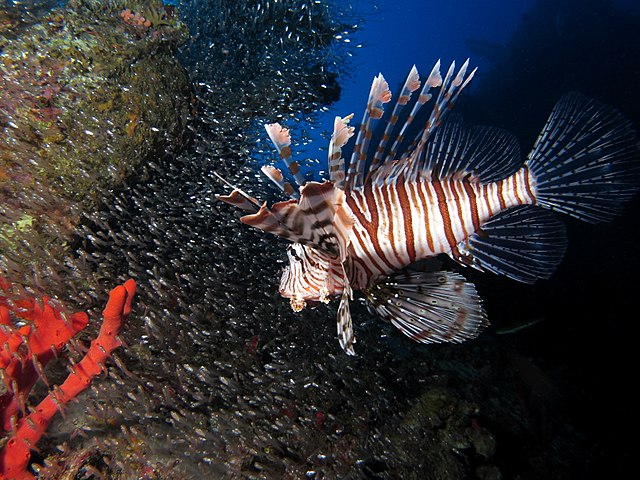
The red lionfish – a native of the South Pacific Ocean
The red lionfish – a native of the South Pacific Ocean, Credit: Wikimedia/Alexander Vasenin

Lionfish are also known as zebrafish, fire-fish, or turkey fish. Similar to zebras, these fish have brown (or maroon) and white stripes on their heads and bodies. Adult lionfish may grow up to 18 inches (45 centimeters) in size. There are two species of lionfish: the red lionfish and the devil fire-fish.

The red lionfish is native to the South Pacific Ocean. The devil fire-fish, also called the Miles’ fire-fish, is native to the Indian Ocean, the Red Sea, and the Persian Gulf. Lionfish are mostly found in warm sea waters at depths of 1 to 300 feet (0.3 to 91 meters) near hard ocean floors, mangroves , seagrass, corals and artificial reef.

Lionfish – Unique Features

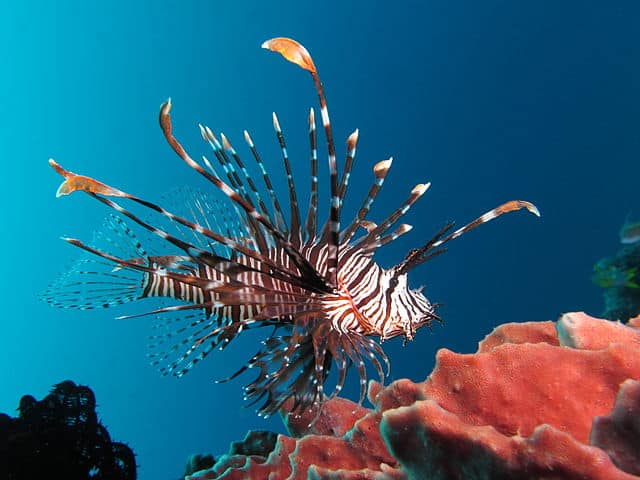
The pattern of the stripes is an identifying feature for the species of lionfish. Apart from their stripes, lionfish have many special features. For example, lionfish have tentacles called wigglers  above their eyes and below their mouths. Wigglers act as bait and attract smaller fish near the lionfish. As soon as the small fish are close enough, lionfish attack them and swallow them at lightning-fast speeds.


Lionfish have fins on their chests, called pectoral fins , which can be opened and closed like a fan. Lionfish use their pectoral fins to hunt for and to corner smaller fish. Additionally, lionfish have elongated needle-like spines on their backs called dorsal spines . The poisonous dorsal spines of lionfish can cause a painful sting. Lionfish use these features and their lightning-fast reflexes to capture smaller fish.

A lionfish dwelling in its local habitat
A lionfish dwelling in its local habitat, Credit: National Marine Sanctuaries, National Ocean Service, NOAA

Are Lionfish Poisonous?

Lionfish mostly use their dorsal spines to defend themselves. However, are lionfish poisonous to humans? If one gets accidentally stung by a lionfish, the symptoms can last for days. The venom may cause extreme pain, sweating, problems in breathing, and may even cause paralysis. Lionfish venom is rarely deadly to humans. However, young children, the elderly, or those who are allergic may die because of lionfish venom.

What is lionfish venom? How is this venom produced?

The venom of lionfish is made of a mixture of protein, a toxin, and a substance called acetylcholine .


Acetylcholine is a well-known neurotransmitter  because it is used in the brain for communication. Lionfish venom glands are special organs which produce this venom. These glands are places inside two grooves of the spines. After the spines puncture the skin, the wound comes in contact with the venom glands. Thus, the venom enters the wound. Although rarely deadly, one should immediately seek medical help after getting stung.

Are Lionfish a Problem?

In the early 21st century, the red lionfish species was found to be a stable inhabitant of the waters near the United States, the Gulf of Mexico, and the Caribbean Sea. Its rapid rate of reproduction, the lack of any enemies in these waters, and the decrease in the local species of fish allowed scientists to consider the red lionfish as an invasive species  of these regions. Similarly, the eastern Atlantic waters were invaded by the devil fire-fish species. Scientists believe that the devil fire-fish species reached the Mediterranean basin through the Suez Canal.


These invasive species have the ability to cause harm to reef ecosystems because they are top predators . This means that lionfish are at the top of the food chain in these coral reef environments. Lionfish are known to consume over fifty different species of fish in the oceans. Some of these fish are economically and ecologically important species. Lastly, lionfish compete with the local species of fish for food and space, resulting in a decline in the number of local fish species.

A devil lionfish (also called Miles’ lionfish or common lionfish) on the hunt for smaller fish, Credit: Wikimedia/Alexander Vasenin

Glossary

Mangroves: a type of trees and shrubs that grow in brackish, periodically flooded areas in coastal regions


Corals: colonial organisms that build hard, stony structures on ocean floors and do not move


Artificial Reef: a manmade structure to support marine life


Wigglers: fleshy tentacles on the top of the head and the bottom of the mouth of lionfish


Pectoral Fins: fins located on the chest region of lionfish; they open and close like a fan and are used to corner smaller fish


Dorsal Spines: venomous needle-like projections on the back of lionfish; used for defense


Acetylcholine: a substance that is used in the brain for communication; a well-known neurotransmitter


Neurotransmitter: a substance which is involved in transmitting signals in the brain; used for cell-to-cell communication in the brain


Invasive Species: a species which is not a native species, is a threat to the local species, and harms the local ecosystem


Top Predators: a predator at the top of a food chain, without any predators of its own

Flesch Kincaid Grade Level: 7.6


Flesch Kincaid Reading Ease: 64.8

Harrell, Scott. “7 Interesting Facts about Invasive Lionfish You Might Not Know Yet.” Lionfish Hunting Lodge, 9 Aug. 2013, https://lionfish.co/7-interesting-facts-about-the-invasive-lionfish-you-might-not-know/.


“Lionfish.” Encyclopædia Britannica, Encyclopædia Britannica, Inc., 10 Feb. 2023, https://www.britannica.com/animal/lionfish.


“Lionfish.” Lionfish | National Invasive Species Information Center, https://www.invasivespeciesinfo.gov/aquatic/fish-and-other-vertebrates/lionfish.


“Red Lionfish: National Geographic.” Animals, https://www.nationalgeographic.com/animals/fish/facts/red-lionfish.


“What Is a Lionfish?” National Oceanic and Atmospheric Administration (NOAA)’s National Ocean Service, US Department of Commerce, 28 July 2016, https://oceanservice.noaa.gov/facts/lionfish-facts.html.
Contributors

Copyright @smorescience. All rights reserved. Do not copy, cite, publish, or distribute this content without permission.


Join 20,000+ parents and educators
To get the FREE science newsletter in your inbox!