Table of Contents
Do you know anyone who is scared of spiders? The extreme fear of spiders is known as arachnophobia . Although spiders may seem scary in appearance, what if we told you that there are crabs that look exactly like spiders?
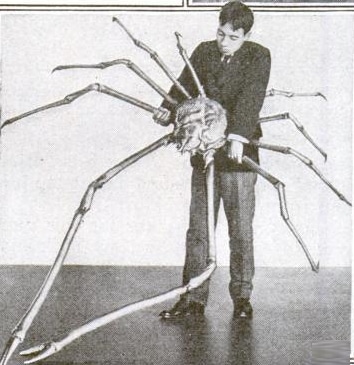
The Japanese spider crab, as one can guess by its name, is one such crab! The Japanese spider crab, along with other species belonging to the family Majidae , look like spiders because of their exceptionally long legs. Unlike spiders, the Japanese spider crab has ten limbs instead of eight. Even though these thick-bodied crabs have extremely long legs, they usually move quite slowly and are pretty sluggish!
How big are Japanese spider crabs?
The Japanese spider crab in particular is one of the largest of crabs, having a size of about 12.5 feet (3.81 meters). This size makes it not just one of the largest crabs, but the largest in the group of organisms known as arthropods . In addition to its great leg-span, the Japanese spider crab may weigh as much as 42 pounds (19 kilograms). On the other end of the spectrum, some spider crabs, such as the long-beaked spider crab, are less than 0.5 inches (or around 1 centimeter) in size.
All spider crabs have thick, round bodies and long, spiderlike legs. The heads of spider crabs are beak-shaped in appearance. The surface of their bodies is covered with hairs, spines, and crooked projections known as tubercles .
Algae, sponges, and other organisms are present on the surface of their bodies. Spider crabs secrete a sticky, mucus-like substance from their mouths which helps fasten organisms to the surface of their bodies. They fasten these organisms to their body surface in order to camouflage themselves as they scavenge for dead or decaying plant or fish matter. This camouflage protects spider crabs from predators. Thus, spider crabs belong to a group of crabs known as decorator crabs.

Where do Japanese spider crabs live?
Spider crabs usually live in temperate ocean waters, where temperatures range from 32º F (0º C) to 72º F (22º C). The Japanese spider crab in particular is found in the waters of the Pacific Ocean next to the country of Japan. Here, the temperature of the ocean waters is around 50º F (10º C).
The Japanese spider crabs are found in the chilly depths of the ocean waters ranging from 164 feet (50 meters) to as low as 1,640 feet (500 meters). During the mating season, these species of spider crabs move to the shallower ocean waters. The mating season in Japanese spider crabs extends from the month of January to April.
In the shallower ocean waters, female Japanese spider crabs lay eggs which may hatch after ten days. As not many eggs will live to hatch, female Japanese spider crabs lay more than a million eggs, each 0.03 inches (0.76 millimeters) in size. After hatching, young spider crabs get no parental care and are left to fend for themselves. Japanese spider crabs go through many stages of molting or shedding of their outer covering—to finally reach adulthood.
Flesch Kincaid Grade Level: 7.6
Flesch Kincaid Reading Ease: 67.9
Glossary
Arachnophobia: an extreme fear of spiders
Arthropods: a phylum of animals with hard bodies and without backbones
Majidae: a family of crabs, including most of the spider crabs
Tubercles: small, rounded projections on the surface of an animal
Camouflage: the manner in which an organism blends into its surroundings
Molting: the shedding of outer covering, cuticle, or skin
References
“Japanese Spider Crab, Facts and Photos.” Animals, https://www.nationalgeographic.com/animals/invertebrates/facts/japanese-spider-crab.
Neal, Emily. “What Is the Difference between a Temperate & Tropical Ocean?” Sciencing, 6 July 2021, https://sciencing.com/difference-between-temperate-tropical-ocean-8035716.html.
Spencer, Joanne. “Japanese Spider Crabs – Facts, Information & Pictures.” Animal Corner, 27 Oct. 2022, https://animalcorner.org/animals/japanese-spider-crabs/.
Spider Crab.” Encyclopædia Britannica, Encyclopædia Britannica, Inc., https://www.britannica.com/animal/spider-crab.
Contributors
Copyright @smorescience. All rights reserved. Do not copy, cite, publish, or distribute this content without permission.
SUBSCRIBE TO OUR NEWSLETTER
.......... ..........Subscribe to our mailing list to get updates to your email inbox.
Monthly Newsletter