Table of Contents
Have you ever marveled at how nature effortlessly solves complex problems? It turns out we’re not the only ones taking cues from Mother Nature. Welcome to the intriguing world of biomimicry – a realm where science meets nature’s ingenuity. Some of the most fascinating examples of biomimicry illustrate how nature’s designs inspire groundbreaking innovations.
What is biomimicry?
Biomimicry, in a nutshell, is the art and science of observing and imitating nature’s strategies to solve human problems. Think of it as nature’s own R&D lab, honing efficient designs over millions of years. Scientists and engineers have long looked to organisms and ecosystems for inspiration, recognizing elegant examples all around of nature “solving problems.” There are some interesting cases where natural phenomena have informed impactful technologies. This approach has spurred countless innovations, from energy-efficient buildings mimicking termite mounds to swimsuits designed after shark skin. It’s a testament to how closely intertwined our world is with the natural environment.
The kingfisher-inspired bullet train
One of the most iconic examples of biomimicry is Japan’s Shinkansen Bullet Train, redesigned to mimic a kingfisher’s beak. Engineers faced a problem: the train created a loud boom when exiting tunnels, disturbing nearby residents. Inspiration struck from the kingfisher, which dives into the water with minimal splash. The redesigned, beak-like front of the train not only eliminated the noise but also increased speed and reduced energy consumption.

The lotus effect in self-cleaning materials
Ever noticed how water droplets roll off a lotus leaf, taking dirt with them? This phenomenon, known as the Lotus Effect, has inspired self-cleaning materials. The leaf’s microscopic structure enables water to pick up dirt particles. Mimicking this, scientists have developed surfaces where water droplets gather dirt and self-clean, with potential applications from clothing to solar panels.
Gecko feet and the world of adhesives
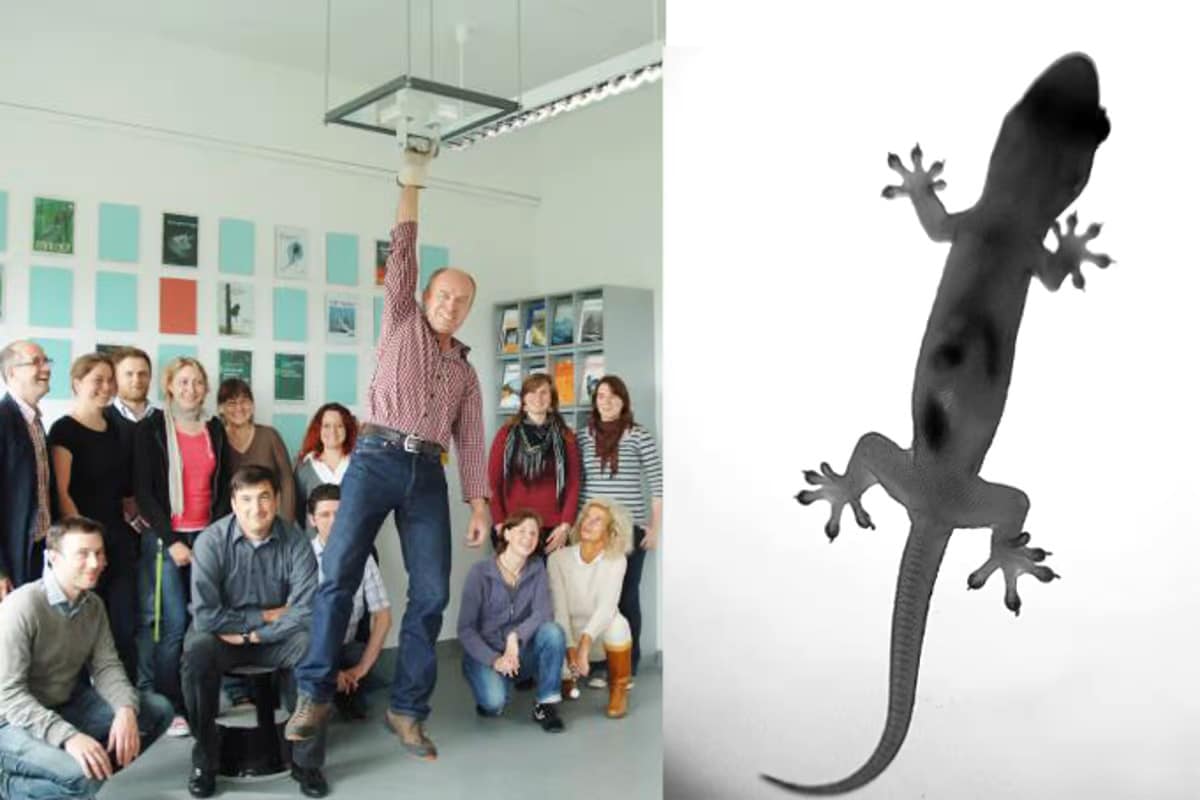
Geckos can climb smooth surfaces effortlessly, thanks to the millions of tiny hairs on their feet. This ability has led to the development of a new class of adhesives. Unlike traditional glues, these biomimetic adhesives are reusable, strong, and leave no residue. It’s a sticky situation that nature handled perfectly!

Shark skin and antimicrobial surfaces
Shark skin isn’t just tough; it’s also resistant to bacteria, thanks to its unique texture. This discovery has led to the creation of antimicrobial surfaces mimicking shark skin, ideal for use in hospitals to reduce the spread of infections. It’s a case of nature’s design offering a bite against bacteria!
The burr and velcro’s invention
Velcro is a classic example of biomimicry, inspired by the burrs that cling to animal fur. Swiss engineer George de Mestral, intrigued by the burrs stuck to his dog, examined them under a microscope. The tiny hooks that latched onto fabric and fur inspired the creation of Velcro, revolutionizing fastening technology.
Whale fins and wind turbines
Humpback whales are agile swimmers, thanks to their uniquely shaped fins. This design inspired more efficient wind turbine blades. By mimicking the bumps, or tubercles, on whale fins, turbines can capture more wind energy, enhancing renewable energy technology.

Termite mounds and sustainable architecture
Termite mounds maintain a constant temperature despite external fluctuations, thanks to their ingenious ventilation system. This natural marvel has inspired architects to design buildings with passive cooling , reducing reliance on artificial air conditioning. It’s a lesson in natural climate control!
The future of biomimicry
The potential of biomimicry is boundless, with ongoing research and new discoveries. From creating sustainable ecosystems to advancing medical technology, nature’s blueprints hold solutions to many of our challenges.
However, it’s important not to overstate nature’s “ingenuity” or imply nature entities actively work to solve problems the way humans do. Nature does not have intentions or goals akin to human ones. Rather, adaptations and strategies evolve over long periods through iterative developmental and selective processes.
Approaching biomimicry with realistic expectations allows us to thoughtfully explore promising areas for innovation inspired by the natural world’s manifold examples of complex form and function. However, as with any new technology, we must consider broader societal impacts with wisdom and care as we translate ideas into practice.
Glossary
Biomimicry: The practice of observing and imitating nature’s designs and processes to solve human challenges.
Van der Waals Forces: Weak forces of attraction between molecules or atoms.
Superhydrophobicity (Lotus Effect): The ability of a surface to repel water, often seen in lotus leaves.
Spatulae: Microscopic structures on gecko feet that enable their strong adhesive properties.
Antimicrobial: Substances that kill or inhibit the growth of microorganisms, such as bacteria.
Passive Cooling: A building design strategy that uses natural processes, like ventilation, to maintain comfortable indoor temperatures without active mechanical systems.
Renewable Energy: Energy from sources that are naturally replenishing, such as wind and solar power.
Sustainable Architecture: Design practices that seek to minimize the negative environmental impact of buildings.
References
“Biomimicry: Innovation Inspired by Nature” by Janine Benyus
“The Biomimicry Manual: What Can Kingfishers Teach Us About High-Speed Trains?” – AskNature.org
“The Lotus Effect: Superhydrophobicity and Metastability” – Langmuir, American Chemical Society
“Gecko Adhesion: Evolutionary Nanotechnology” – Philosophical Transactions of the Royal Society
“Sharklet Technologies: Fighting Bacteria with Biomimicry” – Biomimicry Institute
“Velcro: The Story of a Revolutionary Fastener” – George de Mestral
“Bioinspired Wind Turbine Design: The Potential of Adaptive Morphing Blades” – Energy Reports
“Termite Mounds: Inspiration for Sustainable Building Designs” – National Geographic
Contributors
Copyright @smorescience. All rights reserved. Do not copy, cite, publish, or distribute this content without permission.
SUBSCRIBE TO OUR NEWSLETTER
.......... ..........Subscribe to our mailing list to get updates to your email inbox.
Monthly Newsletter