Nature has painted itself in magnificent colors. From the neon glow of bioluminescence to the myriads of color in poison dart frog s, the beauty of nature is mystifying. Let’s find out some more about some of the most beautiful creatures on Earth.
Mandarin Fish
Physical characteristics
The Mandarin fish is a gem of the underwater world. Its small size, about 3–4 inches long at most, makes it a delightful addition for aquariusm. The fish’s body has a pattern of wavy blue lines on a field of bright orange. The elongated dorsal fin gives it a stunning look, much like a colored vase. The beautiful designs are not all show; they serve as a natural defense mechanism. The bright colors allow the fish to blend in with the coral reefs where it resides.
Mandarin fish have blue lines running amidst orange patches throughout their body, making them look like painted porcelain toys, Credit: Wikimedia/Steve Childs
Behaviors and adaptations
This fish is known for its spectacular mating ritual, where the male performs a mesmerizing dance to attract a mate. Additionally, it has evolved to secrete toxic mucus from its skin, protecting it from predators and making it challenging prey in the underwater world.
Peacock
Physical characteristics
The peacock, specifically the Indian peafowl, is celebrated for its vibrant colors. The male in particular has an extremely long tail with shiny and vibrant feathers. Its elegant and elongated neck adds to its majestic appearance. During mating season, peacocks dance to woo potential partners. At they dance, the peacocks spread their feathers in a superb display.
Peacocks are vibrantly colored in metallic blues and greens, Credit: Wikimedia/Jatin Sindhu
Behaviors and adaptations
The peacock’s grand display is its way of attracting potential mates. This behavior not only exhibits its beauty but also reflects its health and fitness. Interestingly, peacocks are adaptable and can thrive in various environments, so they have become an integral part of folklore and cultural symbolism.
Monarch Butterfly
Physical characteristics
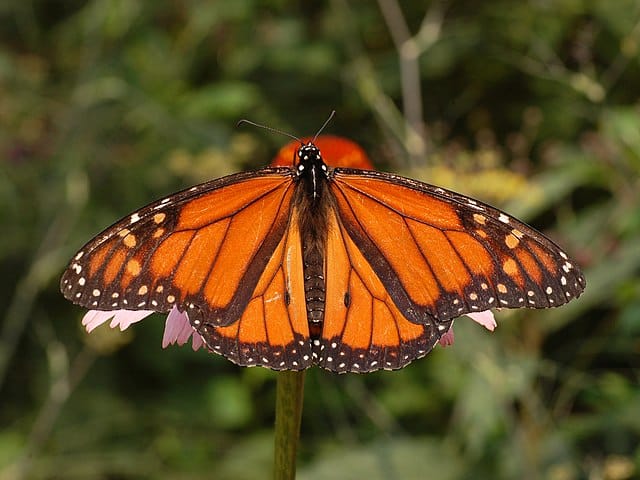
The monarch butterfly is a symbol of delicate grace. The veined wings look like they are made from stained glass. Their wingspan ranges from 3.5 to 4 inches. The monarch butterfly’s vibrant orange and black colors are eye-catching and distinctive. These colors warn predators, as the butterfly contains toxins from the milkweed plants they consume during the larval (caterpillar) stage.
Monarch butterflies travel over 2,000 miles to migrate from the United States and Canada to Mexico during September and October , Credit: Wikimedia/Derek Ramsey (Ram-Man)
Behaviors and adaptations
The monarch butterfly is known for its incredible migratory behavior. Millions of monarchs cover thousands of miles yearly, traveling from North America to southern Mexico. As the length of the day decreases and milkweeds start to age, these environmental triggers set the stage for the migration to begin. To travel such long distances, monarch butterflies fuel themselves by consuming a high-fat diet. They use this fat as an energy source as they travel over 2,000 miles.
Bengal Tiger
Physical characteristics
The Bengal tiger has a deep orange coat with dark stripes, which provides excellent camouflage in the dense jungles where it roams. The tiger’s distinctive stripes are like a fingerprint, with no two tigers having the same pattern.
Every tiger has different stripes; no two tigers are alike, Credit: Wikimedia/Hollingsworth, John and Karen
Behaviors and adaptations
The Bengal tiger is an apex predator , exhibiting exceptional hunting skills. Its stealth, decisive pounce, and sharp teeth and claws make it an efficient and fearsome hunter. A Bengal tiger’s brute strength and power go beyond the land; they are equally agile in water bodies. However, their agility makes them a walking terror in the Sundarbans of India, where reports of tiger attacks on local fishermen are common.
Blue Morpho Butterfly
Physical characteristics
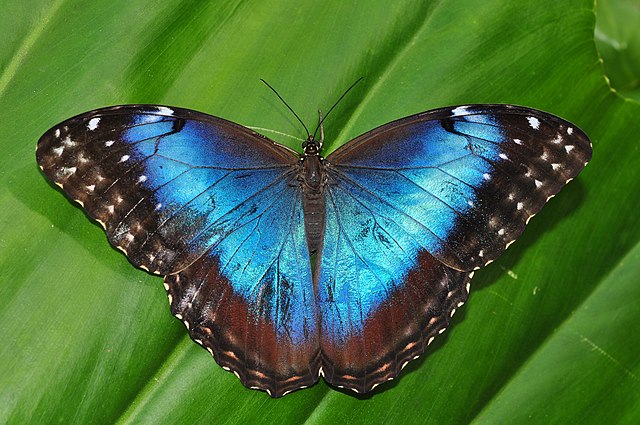
The blue morpho butterfly is a master of disguise. You may have seen a spy flip a jacket to change what they were wearing, to disguise themselves. This butterfly does something similar. It displays a brilliant, metallic blue color when its wings are open. However, when its wings are closed, it reveals a dull brown hue that camouflages it from predators. They have a wingspan of 5–8 inches.
The blue coloration on the upper side of its wings results from microscopic scales, which reflect light to create an eye-catching shimmer. The underside’s brown coloration allows it to blend seamlessly with tree bark and leaves while at rest.
Blue morpho butterflies can close their wings to match the tree bark and leaves on which they rest—talk about blending in, Credit: Wikimedia/ Pavel Kirillov
Behaviors and adaptations
Apart from its color-based adaptations, the blue morpho butterfly is known for its quick and erratic flight, making it challenging for predators to catch. Additionally, it has specialized taste receptors on its feet, aiding it in locating its preferred food sources.
Scarlet Macaw
Physical characteristics
This kin to parrots is an attractive prospect for birdwatchers because of its vivid colors. Its large size, vibrant red, blue, and yellow feathers, and strong beak give it an imposing presence.
Scarlet macaws can make good pets too, Credit: Wikimedia/Kitten Fleming
Behaviors and adaptations
Scarlet macaws are highly social and form strong bonds with their mates. They are excellent mimics and can imitate human speech, making them popular pets in some regions. Sadly, habitat loss and illegal pet trade have threatened their survival.
Golden Pheasant
Physical characteristics
The male golden pheasant, also known as the Chinese pheasant, sports a splendid golden-yellow striped crest on its head which resembles the headdress of a pharaoh. The warm and brilliant gold, red, orange, and green of its feathers make it a spectacle.
Doesn’t a golden pheasant’s crest remind you of a pharaoh's headdress? Credit: Wikimedia/H. Zell
Behaviors and adaptations
The elaborate plumage of the male Golden Pheasant plays a crucial role in courtship displays . During mating rituals, the male spreads its tail feathers like a fan to impress potential mates.
Snow Leopard
Physical characteristics
The snow leopard has thick, silvery-gray fur covered with unique black rosettes and spots, serving as exceptional camouflage in its frozen habitat. The combination of light and dark hair creates a visually striking pattern, which helps the snow leopard remain hidden in rocky terrain and snowy landscapes. Its long and bushy tail provides balance and serves as a makeshift blanket in cold weather.
The only big cat that lives in the Himalayas—the snow leopard, Credit; Wikimedia/Bernard Landgraf
Behaviors and adaptations
The snow leopard is a master climber, with its strong hind legs and incredible agility allowing it to navigate treacherous mountain slopes easily. It has evolved powerful vision, enabling it to spot prey from great distances, even in low light conditions. No other big cat lives at these high elevations, and it has adapted to the freezing temperatures. They have five-inch long fur covering their bellies, which works as a blanket when they lie on the ground.
Mandarin Duck
Physical characteristics
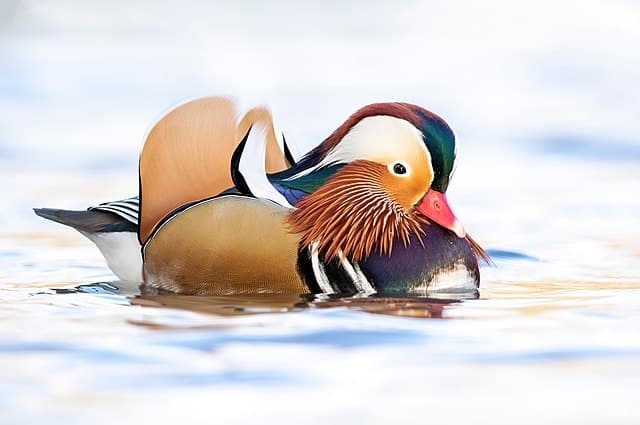
The mandarin duck almost looks like a toy duck with its striking feathers. The male sports a splendid plumage of various colors, including deep orange, purple, green, and white. Although less colorful, the female displays subtle beauty with intricately patterned feathers. Their feathers shine under sunlight, which adds to their beauty.
Mandarin ducks have beautiful orange, white, and purple feathers, Credit: Wikimedia/ Alexis Lours
Behaviors and adaptations
Mandarin ducks form strong pair bonds and often have only one partner throughout their lifetime. During courtship displays, the male engages in head bobbing and wing flapping to impress the female. They are well-adapted to life in wooded wetlands, where they find shelter and food.
Rainbow Lorikeet
Physical characteristics
The name of this bird does justice to its looks. Its head and chest showcase a beautiful combination of blue, green, and yellow, while its abdomen and wings display shades of red and orange. If that isn’t the closest thing to a rainbow, what is?
The rainbow lorikeet looks like a rainbow with wings, Credit: Wikimedia/Andrew Mercer
Behaviors and adaptations
Rainbow lorikeets are highly social birds, often seen in flocks. They are excellent acrobats. Their specialized brush-like tongue allows them to feed on nectar, pollen, and fruit juices, making them an essential part of pollination processes in their natural habitats in Australia.
The Importance of Beauty in Nature
From the mesmerizing patterns on a butterfly’s wings to the vibrant colors of tropical birds, beauty plays a crucial role in the natural world, serving various purposes that contribute to the harmony of ecosystems.
Role in Evolution and Survival
Beauty in nature often functions as a driving force in evolution. Physical characteristics and coloration of animals can influence mate selection, leading to the propagation of specific traits within a population. For instance, the elaborate courtship displays and bright plumage of birds advertise health and help attract mates, ensuring successful reproduction and the continuation of solid genetic lines. This sexual selection process enhances the gene pool, contributing to the species’ resilience and adaptability.
Ecological Significance
Beauty in nature goes beyond biological importance; it also holds ecological and cultural significance. Ecosystems depend on a delicate balance, and the presence of beautiful animals, such as butterflies, bees, and birds, plays a critical role in pollination, seed dispersal, and maintaining biodiversity .
Unfortunately, many beautiful animals face threats that compromise their existence and the balance of nature.
Habitat loss and fragmentation
One of the most significant threats to nature is habitat loss and fragmentation due to human activities such as deforestation , urbanization, and agricultural expansion. As natural habitats disappear or become fragmented, the animals that depend on the habitat lose access to food sources, shelter, and breeding grounds, leading to declining populations and increased vulnerability to predators .
Climate change
Climate change poses another severe threat to beautiful animals and their habitats. Rising temperatures, extreme weather events, and changing precipitation patterns can disrupt breeding cycles, alter migration routes, and affect food availability, pushing some species to extinction .
Illegal wildlife trade
Illegal wildlife trade remains a significant concern for many beautiful animals, including those coveted for their vibrant plumage, fur, or exotic appearance. The demand for these creatures as pets, fashion accessories, or traditional medicines drives poaching and illegal trafficking , leading to population declines and threatening species’ survival.
Nature abounds with beautiful fauna. Unlike other species, we humans enjoy being amazed by their appearance animals. Thus, the duty to safeguard these beautiful animals falls to us.
Glossary
Biodiversity: The variety and variability of living organisms in a particular
Deforestation: The permanent removal or destruction of forests to make way for other land uses, such as agriculture, logging, or urbanization.
Extinction: The complete disappearance of a species or group of organisms from the Earth.
Poaching: Illegal hunting, capturing, or killing of animals, usually for commercial trade or personal gain.
Trafficking: The illegal trade and transportation of animals or animal parts, often for financial gain or black-market activities.
Courtship Displays: Behaviors displayed by animals to attract mates and establish pair bonds.
Sexual Selection: The process by which certain animal traits or characteristics are favored for mating opportunities and reproductive success.
Bioluminescence: The production and emission of light by living organisms, such as certain marine organisms, fireflies, and deep-sea creatures.
Apex Predator: A top-level predator in a food chain that has no natural predators itself and plays a vital role in maintaining the ecological balance of its habitat.