Balloons can be quite the prankster at times. Their bright colors and fun shapes make them a hit at parties and celebrations. But there’s one thing that everyone, young and old, tends to jump at—the loud POP when a balloon bursts. Maybe a balloon’s way of saying “Haha, got you!” But have you ever paused to wonder why balloons pop? In this article, we’ll dive deep into the exciting world of balloons and uncover the mystery behind why balloons burst.
The Science Behind Balloons
Before we discuss why balloons pop, let’s talk a little bit about the science behind balloons. Most balloons that we use for parties and events are made from a stretchy material called latex . This material is elastic, which means it can stretch and change shape when we fill it with air or helium. But it doesn’t just keep stretching indefinitely. There’s a limit to how much it can stretch.
When we blow air or helium into a balloon, it creates what’s known as air pressure. This is the force that the air inside the balloon exerts on the balloon’s material. The more air we put in, the greater the pressure and the more the balloon stretches.
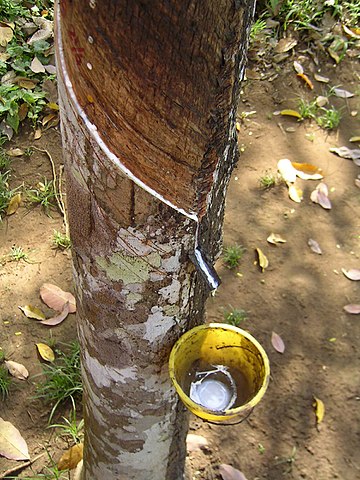
Latex production, Credit: Wikimedia
The Process of Inflation and Over-Inflation
Inflating a balloon is simple, right? You just blow air into it or fill it with helium if you want it to float. But what happens if you put too much air into a balloon? You’ve probably guessed it. The balloon pops.
Over-inflating a balloon causes it to stretch beyond its limit. This over-stretching is not something the material can handle, and it reacts by rupturing or bursting. In other words, it pops. And it’s not a gentle pop. The air inside rushes out in a hurry, causing a loud sound that can sometimes be quite startling!
Inflating a balloon, Credit: Wikimedia/SPÖ Presse und Kommunikation
The Culprit: The Stress-Strain Factor
The main reason why balloons pop boils down to two scientific concepts: stress and strain . In the world of science, stress is the force that’s applied to an object—in this case, the air pressure on the inside of the balloon. Strain, on the other hand, is the deformation or change in shape that the object undergoes due to the stress.
When a balloon is inflated, it undergoes stress from the air pressure and begins to strain, or stretch. If the balloon is inflated too much, the stress becomes too great, leading to too much strain. The balloon’s material cannot handle this excessive strain and eventually gives way. And that’s when we hear the loud POP!
Popping a Balloon by Poking
The other scenario is when we poke a balloon. When a balloon is filled up with air, it is stretched across. However, the tendency of the elastic material is to pull inwards, and release the tension. This force is uniform in all directions. Kind of how a rubber band returns to its original shape when force on it is removed. When you stick a needle or pin inside a balloon, you make a hole, and the balloon loses the uniform tension it had in the area around the hole. But the other parts of the elastic skin still manage to keep the tension intact, hence pulling the rest of the balloon skin towards itself. Hence the balloon makes a pop sound by releasing all the air inside it at high pressure.
Several factors can cause a balloon to pop faster. For instance, heat can speed up the popping process. If a balloon is in a very hot environment, the heat causes the air inside the balloon to expand. This means the balloon stretches more and more quickly, making it more likely to pop.
Altitude can also affect how quickly a balloon pops. The higher the altitude, the lower the outside air pressure. This means the air inside the balloon expands more at high altitudes, stretching the balloon more and increasing the chances of it popping.
Lastly, the most common reason a balloon pops is because of physical puncturing. If a sharp object like a pin or a corner of a table comes into contact with the balloon, it can easily puncture the thin material, causing the balloon to pop.
Conclusion: The Pop Isn’t the End
Balloons can give quite a scare when it pops. But even when a balloon pops, the fun doesn’t have to end. In fact, did you know that when a balloon pops, the remnants can move at speeds faster than a bullet leaving a gun? That’s pretty cool, right?
However, the whole article deals with a balloon popping. What if you want your balloons to give that extra ‘oomph’ and hold it’s air for long, and not deflate? There’s a simple trick, spray some hairspray on the balloon. It acts like a sealant and holds the air or helium for longer.