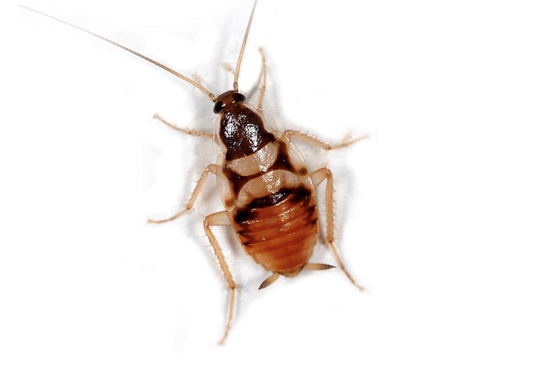
Because of their cosmopolitan distribution, it’s easy to mistake different types of cockroaches as members of a single species. Turns out, there are actually multiple different types of them out there!
Everyone hates cockroaches. They are our unwanted house guests. From the freezing cold of Alaska to the blistering hot deserts of Arizona, they’re everywhere. But did you know that there’s actually more than one type of cockroach?
In fact, there are over 4,000 different cockroach species all over the world!
These species can be divided into two main types of cockroaches: domestic and peridomestic. Let’s find out what these terms mean!
What do these types mean?
Domestic cockroaches refer to any species of cockroach that can’t live out in the wild. These cockroaches need to live around humans. They’re entirely dependent on us! If you were to leave a domestic cockroach out in the desert or in a forest, it wouldn’t have a good shot at survival.
Peridomestic cockroaches, on the other hand, are a more flexible category of cockroaches. They’ll do fine without human interference. These types of cockroaches are also super opportunistic. They’ll seek shelter in buildings when they need to but generally don’t depend on humans.
What are the most common cockroach species in the world?
There are five common species of cockroaches that we can expect to find all over the world. These five species are:
The American Cockroach (Periplaneta americana)
The German Cockroach (Blattella germanica)
The Brown-Banded Cockroach (Supella longipalpa)
The Oriental Cockroach (Blatta orientalis)
The Asian Cockroach (Blattella asahinai)
Let’s explore each of these species one by one. First up, we have the American Cockroach!
The American Cockroach
In terms of popularity, the American Cockroach is the most commonly distributed cockroach species in the world. Contrary to popular belief, the American Cockroach isn’t a native American species! American cockroaches are also very huge. They’re usually between 1.4 inches to 1.6 inches in length but can also grow as large as 2 inches (5 cm).
In the 1600s, a few of these critters boarded ships headed for the United States of America. Upon reaching it, the species adjusted really well to their new home.
The American cockroach is the most widespread roach in the world. Credit: Wikimedia / Wm Jas from Changhua, Taiwan
In terms of shelter, American roaches aren’t too fussy. They’re peridomestic animals that can do equally well for themselves out in the wild or in a domestic setting.
In fact, their most successful home is the sewer system! You read that right, American Cockroaches do really well for themselves in sewer systems. They’ve been known to infest entire networks of canals.
What makes the American Cockroach so successful?
The American Cockroach owes most (if not all) of its success to its genome. Its genome is ridiculously long. In fact, it is the second largest among all insects!
The genome mostly contains repetitive segments. Interspersed in the middle of these gene segments are genes that encode more than 150 scent and 500 taste receptors. These together account for the greatest number of sensory receptors found in any insect (at least as we know so far). These receptors help the American Roach become a super effective and efficient scavenger.
The German Cockroach is the second most common roach in the world. They’re light brown and kind of look like a torpedo. This critter is also a lot smaller than the American cockroach. In fact, they’re among the smallest of all types.
Notice the two vertical stripes on their pronotum? Credit: Wikimedia/Lmbuga
Even adults don’t grow larger than an inch in length! In fact, the largest adults don’t even exceed 0.6 inches (1.6 cm). German Roaches have two vertical stripes that run along the length of their pronotum. No other species has these stripes. This makes the bug super easy to identify.
What makes the German Cockroach so successful?
Don’t let the size fool you. German Cockroaches have many tricks up their sleeve. They’re adept at taking over domestic habitats. This is because they’re small enough to fit in crevices and cracks that usually don’t fit bigger cockroaches like the American Cockroach.
They’re unaffected by many types of insecticidessuch as boric acid or thiamethoxam. This makes these bugs very hard to get rid of. In fact, exterminators have gone so far as to call them indestructible.
To make matters worse for exterminators, German Roaches have a very fast life cycle that lets these bugs easily infest any area available to them.
The Brown-Banded Cockroach
True to their name, they have a series of brown bands that run horizontally along the prothoraxregion of their body. Brown-Banded Roaches aren’t notorious pests.
The bands are most prominent in the nymph stage. Credit: Wikimedia/CrStN224
They look very similar to their German relatives, though the Brown-Banded Roach does not have the two characteristic vertical stripes that German roaches have on their pronotum. They both have small oval-shaped bodies and a light brown color. Brown-Banded nymphs are so small, in fact, that most people don’t even identify them as roaches.
What makes the Brown-Banded Cockroach so successful?
Brown-Banded Roaches are more low-key in the way they work. They aren’t unaffected by insecticides or pesticides like their German counterparts. Instead, they’re all about stealth.
They prefer to stay out of sight. They like hiding in warm and humid areas. Consider dark spaces behind motors or the heated components of refrigerators. However, since American Roaches also prefer such warm and humid regions, the Brown-Banded Roaches are often forced into higher areas and can often be found hiding in air conditioner units.
The Oriental Cockroach
Often known as “Water Bugs,” the Oriental Cockroach is another roach on this list. They are peridomestic cockroaches and are larger than German and Brown-Banded Roches. Yet, they are still smaller than the large American Roaches. They can be identified by one easily noticeable feature: they have no wings!
Notice how the female lacks wings and the male has reduced wings? Credit: Wikimedia/Public Health Image Library (PHIL)
Female bugs do not have any wings while males have extremely small and reduced wings.
Why are Oriental Cockroaches so successful?
These cockroaches are peridomestic species that make the best of both worlds. They are also unlike the other types we’ve seen so far. They prefer cold and damp environments to hot and humid ones.
So, while the Brown-Banded, German, and American Cockroaches compete for the hot and humid areas around the house, the Oriental Cockroaches instead take over cool and damp environments without much competition.
The Asian Cockroach
The Asian Cockroach has a tough run as a species. They’re often either confused with the Oriental Cockroach due to their name or confused with the German Cockroach due to their appearance.
Why are Asian Cockroaches so successful?
Asian cockroaches are the proverbial “new kids on the block.” They only arrived in the United States in the late 1980s. In fact, they’re actually from Japan! They hitched rides on ships from Japan. Successful specimens eventually went on to rule in the U.S.
Asian cockroaches are native to Japan. Credit: Wikimedia/Natasha Wright
They’re peridomestic species that prefer the outdoors to the indoors. You can mostly find them infesting compost piles. They also like living in mulch and grass.
Glossary
Colonization: The process of dispersal and establishment of a new or alien group of animals in a new habitat or range.
Pronotum: The scale-like structure that covers the head of a cockroach.
Prothorax: Refers to the frontal regions of the thorax (or neck) of a cockroach.
Genome: Refers to all the genetic information of DNA in an organism.
Scavenger: An organism that feeds on dead or decaying remains.
Insecticides: Chemicals used to control or kill insects in large numbers.