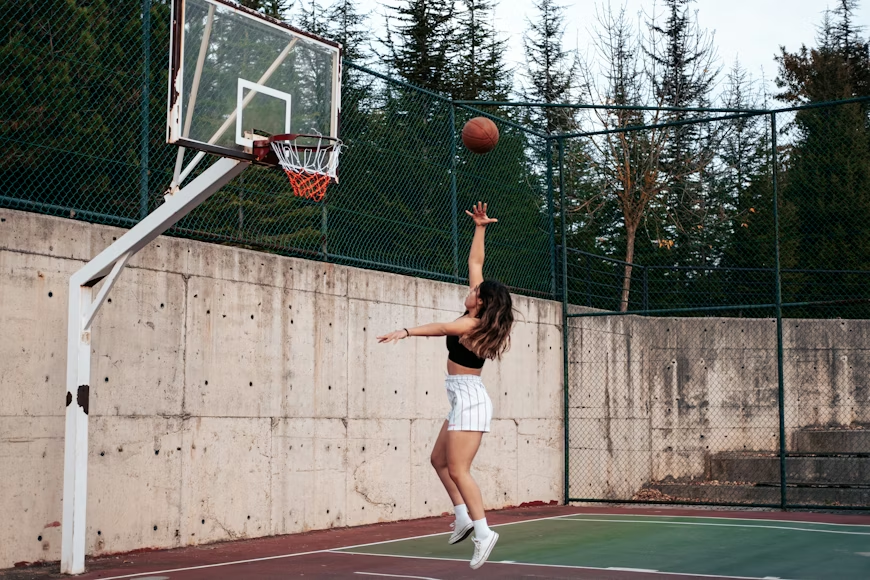
The arena falls into a hushed silence. Thousands of eyes are fixed on a single player standing exactly fifteen feet from the rim. She dribbles—once, twice, three times—breathes, and lets the ball fly. It carves a graceful, invisible arc through the air before snapping the net with a satisfying swish. To the crowd, it looks like magic. But if you peel back the layers of that moment, you’ll find that the perfect free throw is a masterpiece of physics and a real-world application of math. It’s not just a game of hoops; it’s a game of numbers.
The Hardwood Laboratory
A basketball court is a perfect laboratory for studying motion. Since the target never moves and the shooter is never guarded, the free throw is the purest form of basketball physics. The flight of the ball is a classic example of projectile motion. This means that as soon as the ball leaves the player’s fingertips, it is battling two invisible accelerations: the acceleration by the shooter and the constant downward pull of gravity.
The Geometry of Greatness
If you traced a successful shot with a glowing pen, you would see a perfect, downward-opening parabola. The height of this curve is everything. A flat shot makes the eighteen-inch rim look like a narrow, squashed oval. However, a high-arcing shot makes the rim look like a big, open circle. This geometric reality is why coaches tell players to get more arc. A higher arc increases the margin for error, letting the ball drop straight in rather than clanking off the rim.
The Quadratic Secret
The mathematical DNA of this path is a quadratic equation. In class, it looks like y = ax² + bx + c. On the court, these variables are real. The ax² term defines the arc created by gravity, the bx term determines the initial launch angle, while c is the height of the ball when it leaves the hand.
By understanding this math, scientists are able to calculate where the ball will land before it even reaches the apex. For those curious about how this works, using a quadratic formula calculator, you can see how the ball will land depending on your speed and height. While the average player may not even know it, they are calculating the roots of a parabola.
The Search for the Perfect Angle
Researchers at North Carolina State University used computers to simulate millions of free throws to determine the optimal free throw. The results of the simulation indicate that for most players, the optimal free-throw angle is about 52 degrees. This is the angle at which the ball will reach the highest point on the way to the hoop, the vertex.
The simulations also discovered that backspin is the secret weapon for free-throw shooters. The optimal free throw has about three hertz of backspin. This is three complete spins in one second on the way to the hoop. When the spinning ball hits the rim of the hoop, the friction deadens the ball and causes it to fall into the hoop rather than bounce away. This is the famous shooter’s touch.
WNBA Master Class: Elena Delle Donne
Elena Delle Donne is statistically the most accurate free-throw shooter of all time, with a success rate of more than 93%. Her secret is a rigid routine of spotting a specific dot on the floor, taking exactly three dribbles, and making a perfect “L” shape with her arm.
Rather than jumping, which adds more moving parts to the equation, Elena uses a subtle ankle-popping motion. This repeatable motion turns her into a human shooting machine. She even practices while fatigued to ensure her muscle memory takes over during high-pressure game moments.
Redefining the Arc: Caitlin Clark
WNBA star Caitlin Clark also uses high-level physics, but her edge is speed. High-speed cameras have clocked her release at just 0.61 seconds—nearly as fast as NBA legend Stephen Curry. By releasing the ball quickly, she uses the momentum from her legs (the kinetic chain) to create a consistent launch. Even though her “shot pocket” is slightly tilted to the left, her extreme repetition allows her to maintain a 90% free-throw average as a pro.
The Psychology of the Yips
Science isn’t just in the muscles; it’s in the brain. At the free-throw line, a player can sometimes overthink, leading to the yips. This happens when the thinking part of the brain tries to take over a movement that should be automatic. Routines like Delle Donne’s help the brain switch to the “habit center”, letting muscle memory do the work.
Mastering Your Own Shot
You don’t need to be a pro to use these tips. Focus on a consistent routine, aim for the back of the rim, and try to get that 52-degree arc. Understanding the physics of your shot is the first step toward Knowing More and Being More on the court. After all, the universe’s laws of gravity and geometry are always on your side!
References
Carniglia, M., & Slegers, N. (2025). The impact of backspin release modes on basketball spin axis alignment. Journal of Coaching and Sports Science, 4(1), 1-11. doi.org/10.58524/jcss.v4i1.414
Silverberg, L. (2018, March 15). The math behind the perfect free throw. Smithsonian Magazine. https://www.smithsonianmag.com/innovation/math-behind-perfect-free-throw-180968313/
Tran, C. M., & Silverberg, L. M. (2008). Optimal release conditions for the free throw in men’s basketball. Journal of Sports Sciences, 26(11), 1147-1155. doi.org/10.1080/02640410802004948
Copyright @smorescience. All rights reserved. Do not copy, cite, publish, or distribute this content without permission.
SUBSCRIBE TO OUR NEWSLETTER
.......... ..........Subscribe to our mailing list to get updates to your email inbox.
Monthly Newsletter