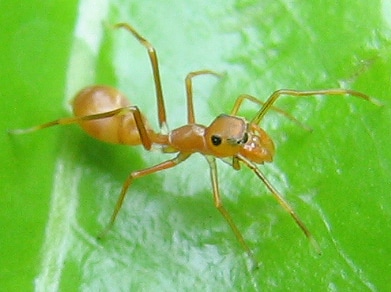
A male ant-mimicking spider. Credit: Wikimedia Commons/Zygy
Has anyone ever told you that there is a spider that looks like an ant? Yes, you read that correctly! There are spiders that look like ants so they can avoid being eaten and catch their prey. These spiders are called “ant-mimicking spiders,” and over time they have changed to look and act like ants. There are various species of ant-mimicking spiders, including the Myrmarachne plataleoides, Cosmophasis bitaeniata, and the Plexippus paykulli, among others.
These spiders have a unique way to stay alive: they look like ants to trick both their prey and their enemies. Any animal that mimics the looks and behavior of an ant is known as a myrmecomorph. Spiders move and act like ants because they want to blend in with their surroundings. They do this by copying the ants’ body language and actions. The spiders appear to have the same number of legs as ants, as their front pair of legs are long enough to look like antennae . Some even go as far as waving their front legs up in the air in a motion like antennae. Nothing suspicious around the corner!
No one likes bad body odor. Spider odor rings alarms for ants, and they would happily make a meal out of the spider. To avoid this, ant-mimicking spiders have evolved to lose their spider scent altogether.
Myrmarachne plataleoides is one of the most common types of spider that looks like an ant. This spider is common in Southeast Asia, where it looks almost exactly like the weaver ants that live there. They are easily recognized by their red and black colors, which are the same as the weaver ants.
Cosmophasis bitaeniata spider. Credit:Wikimedia Commons/ Graham Winterflood
Cosmophasis bitaeniata, also called the “mirror spider,” is another interesting species. The shiny, reflective surface on the abdomen of these spiders looks like the shiny, reflective surface on the body of an ant. This helps the spider blend in with its surroundings even more.
Why mimic an ant?
The most obvious benefit of looking like an ant is that it keeps the spider from being eaten by animals that might mistake it for a tasty snack. Ants aren’t known for being tasty, so birds and other hunters are less likely to go after an ant or a spider that appears to be an ant, than a typical spider. Also, the spider can sneak up on its own prey without being seen because it can blend in with a group of ants.
Spiders that look like ants have also been seen living in ant colonies, which is another advantage for them. By living near their prey, they can use the hard work of the ants to catch their own food. Some spiders that look like ants have even been seen stealing food from the ants themselves. This is called kleptoparasitism .
Ant-mimicking spiders are a set of fascinating species that have developed a unique way of survival. Their ability to mimic the appearance and behavior of ants has helped them to avoid predators and capture their prey. With their diverse species and interesting behavior, these spiders are truly a marvel of nature.
Flesch Grade Level: 8
Flesch Reading Ease: 67.8
Glossary
Antennae: Sensory organs that protrude from the head of insects, crustaceans, and some other arthropods, which are used for touch, smell, taste, and hearing.
Kleptoparasitism: A behavior in which an animal steals food from another animal that has already obtained it through hunting, foraging, or other means.