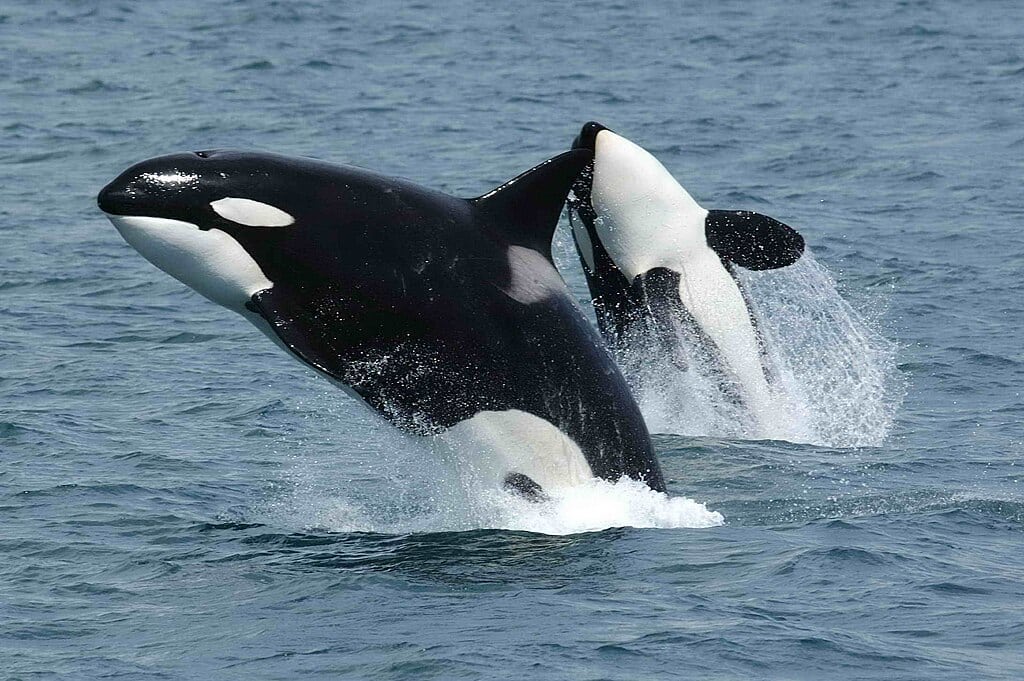
Behavioral ecologist Michael Weiss was browsing through drone footage of orca pods in the Salish Sea. In this footage, he found one of the orcas carrying something green in its mouth. He also noticed a peculiar behavior: Some orcas rubbed against each other for up to 15 minutes at a time. These orcas were engaging in a behavior named allokelping, in which they rubbed pieces of kelp on each other. Weiss and his team recorded 30 instances of this behavior. They found that the southern resident orcas — a distinct population of killer whales — uprooted bull kelp from the seafloor to roll between their bodies. This discovery is the first instance of a cetacean species — marine mammals like whales, dolphins, and porpoises — using a tool to groom themselves.
Weiss hypothesizes that allokelping behavior has two reasons. One of the reasons is to maintain hygiene, such as removing dead skin cells. Removing dead skin cells keeps the orca’s body smooth, streamlined, and aerodynamic. Gray patches of skin lesions are becoming more prevalent in southern resident orcas. Allokelping might be a behavior aimed at curing those lesions. Cetaceans have sensitive skin, and orcas have been recorded rubbing against other objects like smooth-pebble beaches in Canada and algal mats. However, it is unusual to record two different orcas exfoliating each other using kelps as tools.
The other hypothesis indicates that allokelping is a way to socially bond, as whale pairs seen performing this activity were of similar age or were close relatives. Orcas have large brains compared to their body size, and some parts of their brain are more developed than humans. Orca pods even have their own dialects. Clearly, the orcas are incredibly socially bonded.
Killer whales are not the only cetaceans recorded using tools. Some bottlenose dolphins have been recorded removing and using sponges to scare up prey on the seabed. They have also been recorded slapping the seabed with their tails in circles to create mud-ring plumes that trap fish. Humpback whales create bubble nets to catch prey. However, in the case of bottlenose dolphins and humpback whales, they use tools to forage for food. In contrast, allokelping in killer whales is a way to maintain skin health and bond; in other words, it is a cultural practice.
“This idea of allogrooming (with tools) is largely limited to primates, which is what makes it remarkable,” said Philippa Brakes, a behavioral ecologist with the nonprofit Whale and Dolphin Conservation who was not involved with the research. “This kind of feels like a moment in time for cetaceans, because it does prove that you don’t necessarily need a thumb to be able to manipulate a tool.”
Brakes, who studies social learning and culture in cetaceans, adds that the importance of culture in cetacean species is visible through research like this. Each population of southern resident orcas has a distinct dialect for communication and foraging strategies. In a rapidly changing world, cultural advancements provide species with phenomenal ways to adapt and survive.
Southern resident killer whales are critically endangered, with only 74 of them alive in the wild. They are federally protected in the United States and Canada. Bull kelp is also dwindling because of human activities that disrupt the seabed and due to heat waves resulting from climate change. This has led to an overall degradation in the ecosystem.
Kelp forests are also home to juvenile chinook salmon, a key part of southern resident orcas’ diet. The killer whales are spending less time in the Salish Sea, potentially due to the dwindling prey population. According to Monika Wieland Shields, cofounder and director of the non-profit Orca Behavior Institute, even though the population of salmon has dwindled, killer whales might be visiting the Salish Sea just for allokelping.
Copyright @smorescience. All rights reserved. Do not copy, cite, publish, or distribute this content without permission.
SUBSCRIBE TO OUR NEWSLETTER
.......... ..........Subscribe to our mailing list to get updates to your email inbox.
Monthly Newsletter