For decades, scientists have believed that same-sex reproduction in mammals was impossible—a biological roadblock dictated by genetics. But in a groundbreaking achievement, researchers at the Chinese Academy of Sciences (CAS) in Beijing have defied this assumption, successfully creating mice from two biological fathers. These bi-paternal mice (mice produced using genetic material from two male parents) not only survived but also grew into adulthood, marking an unprecedented breakthrough in reproductive science. This discovery could reshape our understanding of genetics, embryonic development (the process by which an embryo forms and develops), and even regenerative medicine (a field of medicine focused on replacing or regenerating damaged cells, tissues, and organs).
In mammals, reproduction requires genetic material from both a male and a female due to a phenomenon known as genomic imprinting—a process that controls how certain genes are expressed depending on whether they come from the mother or father. Previous attempts to create offspring from two males failed, with embryos stalling before full development. Scientists had assumed that overcoming this genetic programming (the biological instructions within DNA that dictate how an organism develops and functions) was nearly impossible.
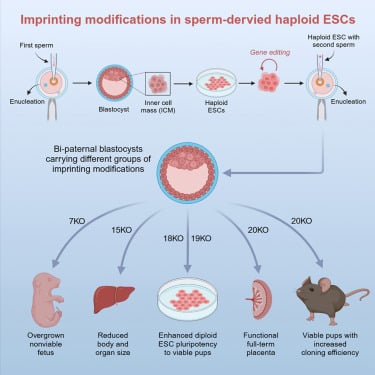
However, the CAS research team developed an innovative genetic approach, one that could rewrite the rules of reproductive biology (the branch of biology that studies the reproductive processes in living organisms). Rather than attempting to create artificial eggs—an approach that had previously failed—they precisely edited key genetic sites in stem cells (undifferentiated cells that can develop into different types of specialized cells), breaking through the imprinting barrier (the natural genetic limitations that prevent same-sex reproduction in mammals).
Using a novel gene-editing technique (a scientific method used to alter DNA sequences to change how genes function), researchers targeted 20 specific genetic regions in mouse embryonic stem cells to bypass genomic imprinting—a major roadblock in same-sex reproduction. The result? Healthy mice born from two fathers for the first time in history.
A particularly stunning outcome of the study was the successful creation of functional placentas (a temporary organ that develops during pregnancy to provide nutrients and oxygen to the embryo) from bi-paternal embryos. In mammals, the placenta requires contributions from both maternal and paternal genes to develop properly, making the full development of a placenta for bi-paternal mice a major milestone in reproductive science.
The study also demonstrated that precisely altering imprinting genes could improve embryonic stem cell development, which has potential implications (possible applications or consequences) for regenerative medicine and cloned animal research.
Rather than attempting to create artificial eggs, the research team used advanced genetic engineering techniques to edit key regions of the genome responsible for genomic imprinting. By removing or modifying specific genes, they were able to trick the cells into functioning as if they contained a balanced genetic contribution from both parents.
The embryos were then implanted into surrogate female mice, where some successfully developed into full-term, viable offspring. The team carefully tracked the development, growth, and behavior of these bi-paternal mice, revealing unexpected physiological differences from traditionally conceived mice. The bi-paternal mice displayed faster growth rates and lower anxiety-like behaviours but had shorter lifespans than typical mice, living about 60% as long.
This research represents a major shift in reproductive science. “These findings provide strong evidence that imprinting abnormalities (errors in gene expression due to incorrect genomic imprinting) are the main barrier to mammalian unisexual reproduction,” explains Guan-Zheng Luo of Sun Yat-sen University in Guangzhou. The ability to manipulate genomic imprinting could open new doors for stem cell therapy (a type of treatment that uses stem cells to repair damaged tissues), cloning (the process of creating a genetically identical copy of an organism), and regenerative medicine, making it one of the most significant genetic breakthroughs in recent years.
However, the study also raises complex ethical questions about the future of reproduction. While the researchers are exploring how to apply this technique to larger animals, human applications remain strictly off-limits due to ethical and regulatory concerns. The International Society for Stem Cell Research (ISSCR) prohibits the use of genome editing for human reproduction, citing safety risks and ethical implications.
“The unique characteristics of imprinting genes have led scientists to believe that they are a fundamental barrier to unisexual reproduction in mammals,” explains Qi Zhou, co-corresponding author from CAS. “Even when constructing bi-maternal or bi-paternal embryos artificially, they fail to develop properly, and they stall at some point during development due to these genes.”
While human applications remain far off the table (not currently possible or allowed), the next step for the researchers is to explore whether this technique can be used in larger mammals and to study the long-term effects of imprinting modifications. Further research is needed to understand why bi-paternal mice had shorter lifespans and whether similar genetic modifications could be applied for cloning, species conservation, or regenerative therapies.
This groundbreaking study challenges the long-standing notion that mammalian reproduction is strictly limited to opposite-sex parents. While this discovery is still in its early stages, it opens fascinating possibilities for the future of genetic science. Whether it leads to new treatments for infertility, regenerative medicine, or a deeper understanding of cellular development, one thing is certain—this research has rewritten the biological rulebook.
For more details, read the full study on ScienceDirect.
Copyright @smorescience. All rights reserved. Do not copy, cite, publish, or distribute this content without permission.
SUBSCRIBE TO OUR NEWSLETTER
.......... ..........Subscribe to our mailing list to get updates to your email inbox.
Monthly Newsletter