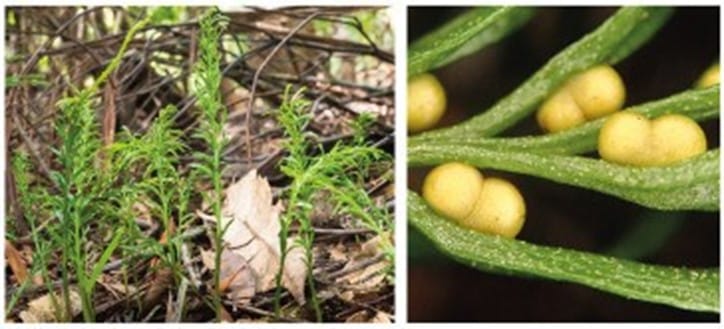
An unassuming little fern found only on the remote Pacific islands of New Caledonia and Vanuatu has shattered the world record for the largest genome of any organism on Earth. The Tmesipteris oblanceolata fern, which grows just 5-10 cm tall, packs an astounding 160.45 billion base pairs (Gbp or gigabases) of DNA into the nucleus of each cell – over 50 times more than the 3.2 billion base pairs in human cells.
If the DNA from a single cell of this fern could be completely unraveled and stretched out, it would extend over 100 meters (328 feet) in length – taller than the Statue of Liberty. In contrast, our human DNA only reaches about 2 meters (6 feet 6 inches) when unraveled from a cell’s nucleus.
This extraordinary discovery was published on May 31, 2024, in the journal iScience by an international team of plant geneticists led by Pol Fernández and Dr. Jaume Pellicer from the Institut Botànic de Barcelona in Spain. Using a technique called flow cytometry to measure the genome sizes, they confirmed T. oblanceolata had definitively surpassed the previous plant record holder, the Japanese Paris japonica, with its 149 billion base pair genome.
Top 10 of the largest genome size records available in eukaryotes.
Credit: https://www.cell.com/iscience/fulltext/S2589-0042(24)01111-8
While possessed of this gargantuan genome, T. oblanceolata doesn’t appear exceptional on the surface.
In fact, having such a massive genome may be more of a disadvantage for the fern. Larger cell sizes are required to fit all that DNA, which can impair critical functions like photosynthesis and reproduction.
How does it function? How does it survive with that much DNA in it? While these questions are yet to be answered, the researchers admit much of this excessive DNA may be non-coding “junk,” though its purpose remains unclear.
While T. oblanceolata is the first organism confirmed to exceed 160 billion base pairs, even larger plant genomes may still await discovery in nature’s treasure troves of biodiversity. This record-shattering fern highlights just how much more there is to uncover about the wondrous genetic variety across the tree of life on our planet.
Organism
Genome Size
Notes
Tmesipteris oblanceolata (fork fern)
160.45 Gbp
New record holder as of 2024
Paris japonica (Japanese plant)
149 Gbp
Previous record holder among plants until 2024
Tmesipteris obliqua (fork fern)
147.3 Gbp
Close to record in 2017
Protopterus aethiopicus (marbled lungfish)
129.9 Gbp
Current animal record as of 1972
Viscum album (European mistletoe)
94 Gbp
Largest plant genome sequenced/assembled as of 2022
Neoceratodus forsteri (Australian lungfish)
43 Gbp
Largest sequenced/assembled animal genome as of 2021
Ambystoma mexicanum (axolotl salamander)
32 Gbp
Previous largest sequenced animal genome until 2021
Homo sapiens (humans)
3.2 Gbp
For comparison
Organisms from largest known genome size down to the human genome for reference.
Copyright @smorescience. All rights reserved. Do not copy, cite, publish, or distribute this content without permission.
Join 20,000+ parents and educators
To get the FREE science newsletter in your inbox!
SUBSCRIBE TO OUR NEWSLETTER
.......... ..........
Subscribe to our mailing list to get updates to your email inbox.