Although her life was filled with obstacles, Lise Meitner didn’t let anything stop her from exploring the world and achieving her dreams.
While other people were busy with Christmas celebrations, a woman went for a walk in a Swedish forest. She had a lot on her mind. She had been getting strange letters from her friends researching atoms. The results they were getting from their experiments were confusing. So as her feet crunched through the snow and the cold air hit her face, she was trying to work it out. She sat down and started adding things up using Einstein’s famous equation: E =mc2.
This was the moment that Lise Meitner worked out what was going on! It was the result of years of work involving lots of universities and people in different countries. But after fleeing from the Nazis, being denied an education, and working late nights, it was Lise Meitner who cracked it using determination and mathematics.
Lise was born on November 7, 1878, in Vienna, Austria. She was a curious girl, interested particularly in mathematics, but at fourteen years old she was no longer allowed to go to school. Lise was bored. She loved reading and playing the piano but wanted to learn more. How could she uncover the secrets of the universe from her house? She wanted to be a scientist, and she knew that to do that she needed to study at the University of Vienna. It is hard to imagine a time when school was so different to how it is for most of us today. But in Austria at this time, it was against the law for women to study. Lise wasn’t allowed to go to school! But did this stop her? Not at all.
Her Father was supportive of her dreams but recommended that she train to be a teacher instead. When she qualified, the University of Vienna had luckily just started taking applications from women. In February 1906, Lise graduated with a Ph.D. in physics and started staying up late into the night to continue her studies even further. She was interested in a phenomenon that had just been discovered – radioactivity.
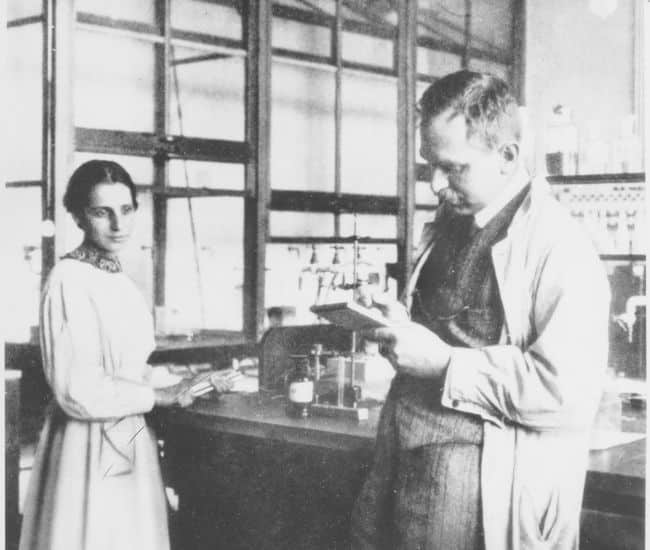
She moved to Berlin where she met chemist Otto Hahn.A couple of years later, the science duo moved to the new Kaiser Wilhelm Institute for Chemistry. Once again, Lise hit a barrier. Her only option to study at the cutting–edge research institute was by setting up some equipment in a cupboard.Women were not allowed in the laboratories. If that wasn’t bad enough, they didn’t even pay her for the first year!
Lise Meitner and Otto Hahn
The idea of the atom experiments was to take neutrons ( tiny particles in the middle of an atom) and blast them at the nucleus (the center) of another atom. In theory, the smaller neutron being blasted at the bigger nuclei would cause the neutron to stick to the nuclei and make them heavier. But every time they did the experiments the atom they were blasting neutrons at appeared to be lighter. This didn’t make sense, so scientists set about trying to work out why.
Then disaster struck. The Nazis had taken over Germany and had started persecuting Jews – and Lise was of Jewish descent. She stayed for as long as she could, knowing there was little of her vital research she would be able to take with her. Finally, Otto Hahn told her it would be best for everyone if she stopped coming into work. She was hurt and felt let down by her old friend, but he was right that her life was in danger.
Lise crossed the border in secret on the night of July 13, 1938 with hardly any possessions, arriving in Sweden with just some basics and a diamond ring from Otto to bribe border guards. And it was here, when she took her walk in the woods, that she realized that the neutrons were not sticking to the nucleus – they were being smashed into two lighter pieces! Meitner called thisnuclear fission, and she calculated that it could make massive amounts of energy. Nuclear power was born!
Nuclear fission is a reaction that splits an atom and releases tremendous energy
Lise Meitner never returned to Germany and died aged 89. She had published 129 scientific papers. Though she didn’t share the Nobel Prize in Chemistry for nuclear fission (which she should have, but it was given exclusively to Otto Hahn instead), she received many awards and honors. After her death, even an element was named after her (Meitnerium!).
So the next time you’re in math, remember Lise Meitner – the fierce little girl who fought so hard to study and went on to change the world.
Glossary
Atom – the smallest particles that make up everything in the universe
Neutron – a particle in the centre of the nucleus of an atom that does not have an electric charge
Radioactivity – energy or particles by the breaking apart of atoms of certain elements