Say you’re trying to mix oil and water. No matter how hard you try, they just won’t blend together. They always separate, with the oil floating on top of the water. That’s because oil and water are immiscible , which is a big word meaning they don’t mix together. But, with the help of a special ingredient, you can get them to mix. That ingredient is called an emulsifier . Emulsifiers reduce the surface tension of water, that allows the tiny fat droplets to mix. Surface tension is the tendency of a liquid to occupy the least surface area, hence acting like a stretched membrane. If you ever punched the surface of water, you’ll find that the surface of the water feels solid.
Emulsion are a mix of two liquids that normally don’t like to mix, like oil and water. But, with the help of an emulsifier, they can come together. The emulsifier helps to break up the oil into tiny droplets and spread them out in the water. This forms an emulsion, a mix where the two liquids are evenly spread out in each other.
Emulsions are everywhere around us. Some common examples include milk, mayonnaise, and lotions. In these products, emulsions help to combine different ingredients into a smooth and stable mixture.
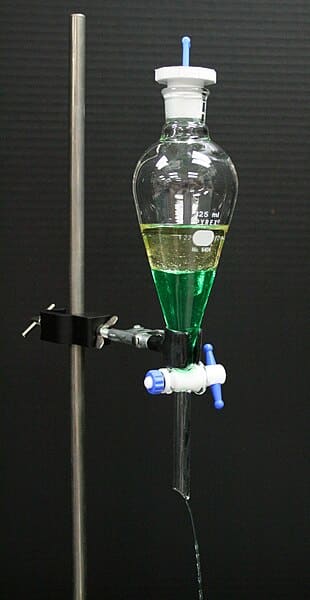
Oil and water separation, Credit: Wikimedia/PRHaney
Basics of paint
Now, let’s turn our attention to paint. Paint is a very familiar thing. It’s the liquid that we use to color everything from the walls in our house to the pictures we draw. Paint comes in many types, and each type is good for different uses.
For example, watercolor paint is great for making art on paper. It’s made with pigment that can be easily mixed with water. Oil-based paint, on the other hand, is good for painting things like model cars or wooden furniture. It’s made with pigments that are mixed with oil, which makes it durable and glossy.
No matter what type it is, all paints are made up of three main parts. These are the pigment, which gives the paint its color, the binder , which holds the pigment together, and the solvent , which makes the paint liquid and easy to spread.
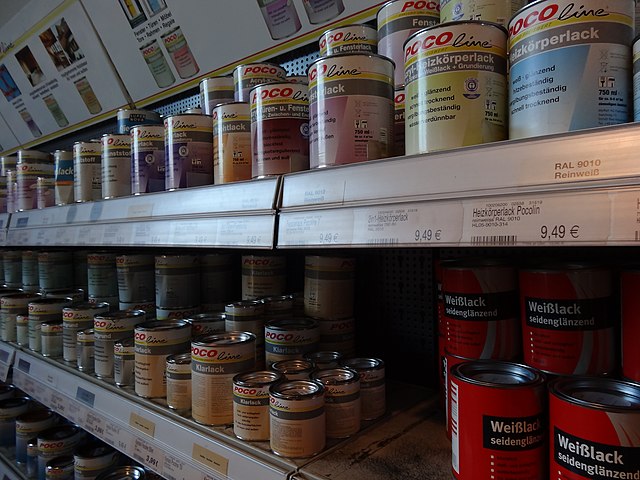
Various paint cans, Credit: Wikimedia/Kalispera Dell
How is paint an emulsion?
Here’s where things get interesting. Is paint an emulsion? The short answer is yes, most types of paint are emulsions. This is because when we mix the pigment, binder, and solvent together to make paint, they don’t fully blend into one another.
Instead, the pigment and binder form tiny droplets that spread out in the solvent. This is just like how the emulsifier helps to break up the oil into tiny droplets in water. So, we can say that paint is an emulsion, where the pigment and binder are the oil, and the solvent is the water.
Role of emulsions in paint
So, why do we want paint to be an emulsion? It turns out that emulsions are very useful for making good paint. Here’s why.
When you paint something, like a wall, you’re actually spreading these tiny droplets of pigment and binder onto the surface. As the solvent starts to evaporate or dry up, these droplets come closer together. Eventually, they stick together to form a solid, colorful layer on the wall.
This process, where the liquid paint dries to form a solid layer of color, is crucial for painting. And it’s all possible because of the emulsion in the paint.
After this process, no amount of water can dissolve the paint back. That means, dried paint on the wall is waterproof.
Painting a wall, Credit: Wikimedia/Pankajkukreti03
Quality of paint and emulsions
The way the emulsion is made can have a big impact on the quality of the paint. If the emulsion is well-made, the droplets of pigment and binder will be evenly spread out in the solvent. This will help the paint to spread smoothly and evenly on the surface.
If the emulsion is not well-made, the droplets may clump together. This can lead to lumps and streaks in the paint, which are not good at all.
The choice of emulsifier is also very important. The emulsifier needs to be able to mix the pigment and binder well with the solvent. It also needs to help them stay mixed for a long time. This will ensure that the paint keeps its quality, even if it sits in the can for a while.
In conclusion, paint is indeed an emulsion. It’s a mix of pigments and binders, all floating in a liquid solvent. This mix, or emulsion, is what gives paint its unique properties. It allows us to spread color on a surface, and then watch as it dries to form a solid, vibrant layer.
So the next time you pick up a paintbrush, remember the science that’s happening in that can of paint. Remember the tiny droplets of color that you’re spreading, and how they come together to create the final picture. And most of all, remember the incredible role of emulsions in making it all possible. Isn’t science amazing?
Glossary
Emulsion: A mixture of two liquids that usually don’t mix, but with the help of a third substance called an emulsifier, they can be combined.
Pigment: The part of the paint that provides color.
Binder: The ingredient in paint that helps the pigment stick to the surface being painted.
Solvent: The part of the paint that keeps it liquid and helps to spread it evenly on a surface.
Emulsifier: A substance that helps to mix two immiscible liquids together.
Immiscible: A term used to describe liquids that don’t mix together well.