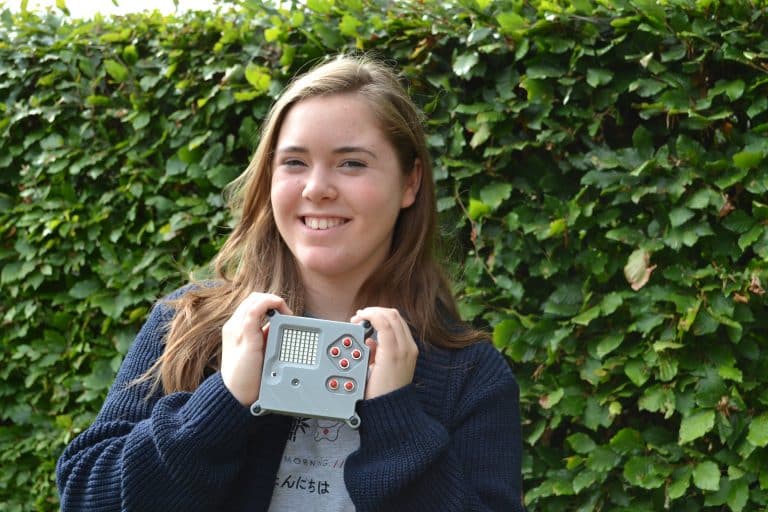
Lowena Hull has yet to meet a type of tech she doesn’t like – 16 years and counting. Her code won the national Astro Pi competition and played music on the International Space Station. She alsoworked with teams to design codes to locate charging stations and identify potential skin conditions – the later for which she is being flown to San Francisco to mentor at the Girls in AI Global Hackathon. She is interested in everything from machine learning to cybersecurity, and she loves helping other young people find their own passion in the technical world.
1. You clearly have a passion for working with and learning about technology. What do you enjoy the most about it?
The ability to create things that seemed impossible before. It’s the best feeling in the world when something starts to work, it might not work completely, but when you can start to see it all coming together.
2. You worked with computers before your first Astro Pi competition, but coding websites is different than coding for a piece of hardware. How did you learn what you needed to design your code for the International Space Station?
There’s this great book called Python Programming for the Absolute beginner (3rd edition) which is great to use as an introduction to python. I spent two weeks studying that and the many tutorials online by Raspberry Pi foundation.While HTML and CSS are great for coding websites, they bear very little resemblance to Python, so the change was a bit tricky, but its manageable!
Even if you think you're too busy, even if you think you have no time - start today.
3. How did you get started volunteering at Raspberry Pi Jams? What are they like and why do you enjoy going to them?
A friend of mine got me in touch with the guy who runs the Bogor Regis Raspberry Jams. He asked if I could volunteer at an upcoming event, and I said sure. I found helping to teach kids was actually pretty fun. I’ve been attending Raspberry Jams ever since. People turn up with their projects, which range from mini arcades to button-pressing games. It’s a great opportunity to talk to people about their passion. I enjoy the community feel, and the joy of discovering all the different ways Raspberry Pis are being used.
4. You have competed both on your own and as part of a team. What is different about the process and what is the best/hardest about each?
Working on my own waspretty tough – youhave to do all the research and work yourself. I tend to lose myself in my work when I’m working alone and can easily work 8+ hours in a row without break.It’s great for productivity, but when I get stuck on something I sometimes wish there was someone to talk it through with. When working in a team, different people have different skills which can be useful especially if we’re working on something I’m not too strong at. It’s also a lot more fun!
5. How did your team decide to create an app that could scan for skin conditions? What about taking on that challenge surprised you the most?
We looked at the UN Sustainable Development goals, which list 17 global goals the UN aims to tackle by 2030.We settled on number three: Good health and well-being. This project was different,as I’d never worked on image processing software and AI before. It surprised me how versatile and helpful machine learning could be in the analysis of hundreds, sometimes thousands, of images.
6. Even though you are still a student, you have explored subjects all across science and engineering. What motivates you to take on a new area?
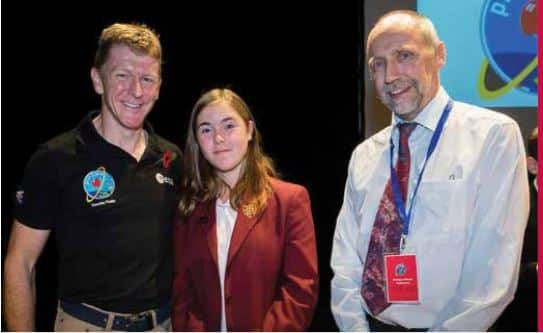
Lowena with British astronaut Tim Peake (Left)
Curiosity. I’ll see something and I’ll think, “That’d be fun to try.”Before I know it, I’m doing a week-long course and wondering how I ended up there. I like to try new things, especially if there’s a competition or project. I love project-based learning. I think a project or hands-on learning is probably the best way to understand something.
7. What advice would you give to someone who might want to write their first code, learn a new language, or explore a new subject?
Start today. Even if you think you’re too busy, even if you think you have no time – starttoday. Or else you’ll end up putting it off for another day, then another day, until it doesn’t get done. Starting something and doing a little bit of practice every day, even as little as five or ten minutes, gives you that motivation to continue. Also, if you’re not sure whether you should try learning something, I always recommend you do. It’s better to realize you don’t like something than to have never tried.
Amanda is a scholarly publishing professional and science writer. Whether writing articles for interested kids or helping researchers publish their latest books, she has a passion for communicating the latest discoveries to curious readers from college campuses to K-12 classrooms. Her academic and professional careers have pursued a commitment to lifelong learning across the academic spectrum – including a Ph.D. from Cornell’s Department of Earth and Atmospheric Science and undergraduate majors in geology, psychology, and German at Bucknell University. She loves writing for SMORE, because every issue is a chance to tell someone else's story – from physicists to podcasters, public health experts to programmers – and introduce the readers of Smore to who they are and what they do.