Have you ever heard of vulture bees? These bees are not your regular honey makers! Unlike their cousins, who collect nectar from flowers, vulture bees have a very unusual diet. In this article, we’re going to explore the fascinating world of vulture bees and their one-of-a-kind honey.
Vulture bees are primarily found in the tropical forests of Central America down into northwestern South America. Their reliance on year-round nest warmth and accessibility of animal protein in these habitats keeps them concentrated there.
The unique diet of vulture bees
What sets vulture bees apart is their highly unusual diet. While the majority of bees collect the nectar and pollen of flowering plants to produce sugary honey, vulture bees have evolved with a preference for meat instead!
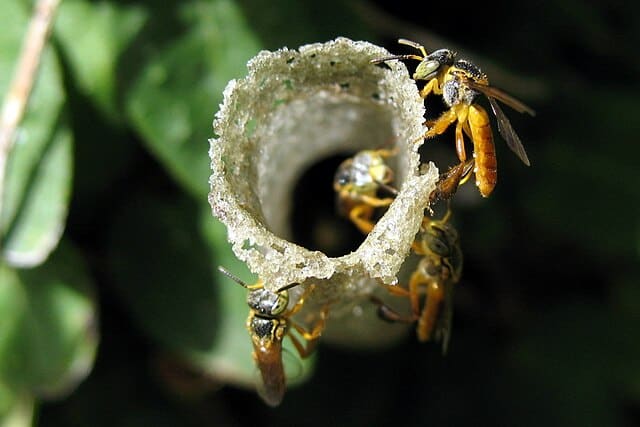
These bees, comprising a subset of stingless bees in the genera Trigona and Lestrimelitta, seek out dead animals in order to feed on their flesh. Equipped with large mandibles well-adapted for slicing into carrion, they will flock to an animal carcass en masse once it is detected. Using their robust mouthparts, they are able to cut through skin, allowing them access to muscle tissue high in nutritious fats and proteins underneath.
Abelha Jatai, Credit: Wikimedia/HelioBeiroz
How vulture bees make their honey
Now, let’s talk about how these meat-loving bees make their honey. Vulture bees collect the protein-rich material from carcasses , which they then return to their hive . Here comes the interesting part: they convert this material into a honey-like substance. It’s not exactly like the sweet honey we know, but it’s honey made by bees!
Comparing vulture bee honey with regular honey
When we think of honey, we imagine the sweet, golden liquid made by bees from flower nectar. But vulture bee honey is different. It’s darker and has a unique taste, thanks to their meat-based diet. Even though it’s not the type of honey you’d find in your kitchen, it’s still a remarkable creation of nature.
The ecological significance of vulture bees
While very different from typical bees, vulture bees provide important ecological services. As scavengers, they rapidly consume and recycling dead animal matter, keeping forests clear of decaying carcasses that could otherwise spread parasites and disease.
Vulture bees have also evolved resistance to some pathogens that cause dangerous infections in vertebrates, allowing them to help control infectious microorganisms that accumulate in rotting flesh. Their niche metabolism and unusual feeding habits are a testament to natural selection’s power to drive incredible adaptation .
Although they will probably never vie with honey bees for starring roles in honey jars, vulture bees deserve appreciation nonetheless. They showcase how diverse and surprising the natural world can be.
Abelha-jatai, Credit: Wikimedia/Demeter
Glossary
Adaptation: A change or adjustment in a plant or animal that makes it better suited to its environment.
Carcasses: The dead bodies of animals.
Nectar: A sweet liquid produced by flowers, which bees and other insects collect.
Recycling: The process of converting waste materials into new materials and objects, often seen in nature as the reuse of resources.
Hive: The structure where bees live and store their honey.