How long can a fish stay out of water?

Table of Contents

“Like a fish out of water” is a common phrase used to describe someone caught in an unfamiliar situation. But how long can a fish stay out of water?


Humans, animals, and birds can survive on land because they have organs that can utilize the oxygen in the environment. For example, earthworms breathe through their skin. Their skin absorbs oxygen. Others, like humans, have lungs to suck in oxygen. But fish do not have these provisions. They have specialized organs called gills . Gills absorb the oxygen dissolved in water. These same gills can’t absorb oxygen on land as they tend to collapse out of the water. Hence, a fish dies when taken out of water.


A fish gulps in mouthfuls of water that then pass through the gills. Gills are packed with tiny blood vessels called capillaries. These absorb dissolved oxygen present in the water, and also release carbon dioxide for expulsion. Just like our noses don’t work underwater, fish gills cannot extract oxygen from the air. As you will see, fish that can breathe air have a primitive form of lung, or they can absorb oxygen through their skin.


The amount of time a fish can stay out of water is determined by several factors, like the type of fish and the environment it gets in when it is taken out of water.

Our beloved: Goldfish

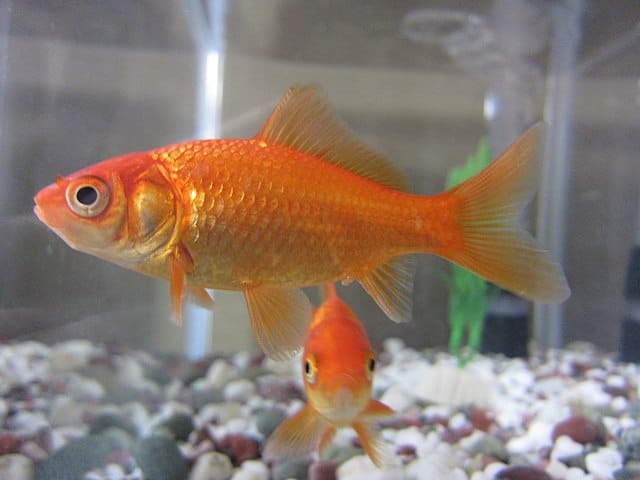
A goldfish can typically stay out of water for around one to three hours. But there may be several reasons this time period can be extended or lessened. If a fish lands on a surface that tends to absorb water, it will die sooner. This is because goldfish can utilize the little amount of water they brought with them. In the case of an absorbent surface, this little water too is absorbed, leading to an earlier death for the fish.

Carassius auratus
Goldfish. Scientific name: Carassius auratus, Credit: Wikimedia commons/ぱたごん

An unusual fish: Mudskipper

Mudskippers are unusual because they spend a lot of time on land. Mudskippers can live on land for two whole days! No, they don’t magically evolve lungs. Rather, they store water bubbles in their breathing organs, the gills. When on land, they can use the oxygen in these water bubbles to survive. They can also absorb air through their skin, further aiding their survival. This type of breathing is called cutaneous respiration .

Periophthalmodon schlosseri
Giant mudskipper on land. Scientific name of the giant mudskipper: Periophthalmodon schlosseri, Credit: Wikimedia commons/Bernard DUPONT

A gill and a lung too?

One lucky fish seems to have it all. Apart from the usual gills, they also seem to have a lung! This characteristic is unique to this species. But the lung that they have isn’t similar to what we have. Their lung is a swim bladder . Swim bladders are cavities that can be filled with air. Hence, they are normally used by fish to maintain buoyancy . It enables them to swim. But the lungfish species has adapted them to be used as a substitute for lungs. It enables the fish to stay out of water for years!

Neoceratodus forsteri
Australian lungfish. Scientific name: Neoceratodus forsteri, Credit: Wikimedia commons/Mitch Ames

Temperature and metabolic rate

Imagine this: you run five miles in hot weather. The temperature is high, and your metabolic rate , too, is high. Hence, you find yourself breathing heavily to get the most oxygen. Similarly, temperature and metabolic activity play a role in determining how much oxygen a fish needs, which in turn decides long a fish can stay out of water. A warmer climate and higher metabolic activity can reduce the time a fish can spend on land, due to higher oxygen requirements.

“I don’t need oxygen!”

When out of the water, fish are unable to get the oxygen they need, as their breathing organs do not work on land. So, the lack of oxygen is the real problem. The primary function of oxygen is to break down the food we eat and release energy that can be used for processes that are essential to survival. No oxygen, no energy, no survival.


But goldfish can survive without oxygen for up to five months! Under low oxygen conditions, they utilize a unique set of enzymes to convert their food to alcohol, which is expelled through the gills. This provides them with the energy they need.

Glossary

Gills: Specialized organs that enable fish to breath underwater.


Cutaneous respiration: A form of breathing by absorbing air through skin.


Swim bladder: An organ that maintains buoyancy.


Buoyancy: Ability to float in liquid.


Metabolic rate: Rate of energy consumption.

Flesch Kincaid Grade Level: 6.6


Flesch Kincaid Reading Ease:  69.7

Van, H. T., Tran, L. X., Dinh, Q. M., Tran, D. T., Murata, M., Sagara, H., Yamada, A., Shirai, K., & Ishimatsu, A. (2019). Land Invasion by the Mudskipper, Periophthalmodon septemradiatus, in Fresh and Saline Waters of the Mekong River. Scientific Reports, 9(1). https://doi.org/10.1038/s41598-019-50799-5


Lushchak, V. I., Bagnyukova, T. V., Husak, V. V., Luzhna, L. I., Lushchak, O. V., & Storey, K. B. (2005). Hyperoxia results in transient oxidative stress and an adaptive response by antioxidant enzymes in goldfish tissues. The International Journal of Biochemistry & Cell Biology, 37(8), 1670–1680. https://doi.org/10.1016/j.biocel.2005.02.024


Pelster, B. (2021). Using the swimbladder as a respiratory organ and/or a buoyancy structure—Benefits and consequences. Journal of Experimental Zoology Part A: Ecological and Integrative Physiology, 335(9–10), 831–842. https://doi.org/10.1002/jez.246


Fagernes, C. E., Stensløkken, K., Røhr, Å. K., Berenbrink, M., Ellefsen, S., & Nilsson, G. E. (2017). Extreme anoxia tolerance in crucian carp and goldfish through neofunctionalization of duplicated genes creating a new ethanol-producing pyruvate decarboxylase pathway. Scientific Reports, 7(1). https://doi.org/10.1038/s41598-017-07385-4
Copyright @smorescience. All rights reserved. Do not copy, cite, publish, or distribute this content without permission.


Join 20,000+ parents and educators
To get the FREE science newsletter in your inbox!