When you see the good guys in movies pull out their pistols and save the day, it can spark a lot of questions in your mind. One of them might be, “Just how far can a pistol shoot?” Pistols are amazing pieces of technology that serve many purposes, from law enforcement to sports shooting, and even in entertainment. Let’s cue the cowboy music and find out more about the shooting range of pistols.
Handgun, Credit: Wikimedia/Transfer Station
Understanding pistols and bullet trajectory
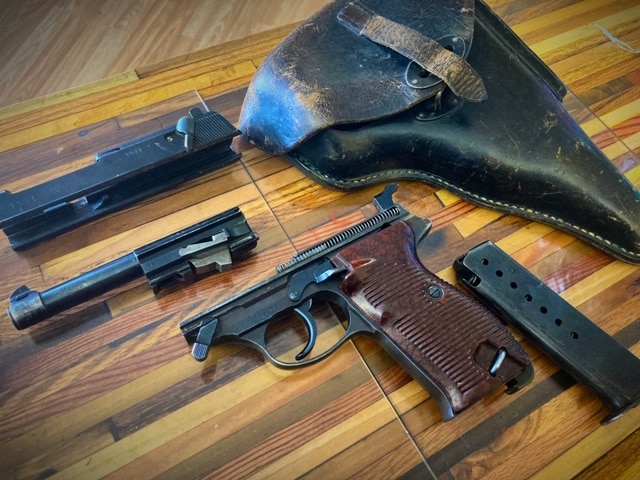
To begin with, we need to get familiar with pistols and bullet trajectory . A pistol is a type of firearm that can be held and used with one hand. It comes in many shapes, sizes, and types.
The bullet trajectory, on the other hand, is the path that the bullet follows once it has been fired from the pistol. Think of a three pointer. When you shoot a basketball, you shoot it with a certain speed and angle, such that it lands inside the hoop. For a three pointer, you need more speed, since the distance is more. But a bullet travels straight, how does that compare to a basketball? A bullet seems like it is traveling straight, but gravity eventually pulls it downwards. But the speed of the bullet is so high that it covers a good deal of distance before plummeting. Since you have seen pistol being used in close range, you can never notice the effect. In reality, the bullet curves, much like the path of a baseball when you throw it. The bullet shoots out, goes upwards, reaches a peak, and then starts falling back down. The total distance that the bullet covers from the start to the end is what we call the ‘range.’
Trajectory, Credit: Wikimedia/Peter Gnanapragasam
Factors that impact pistol range
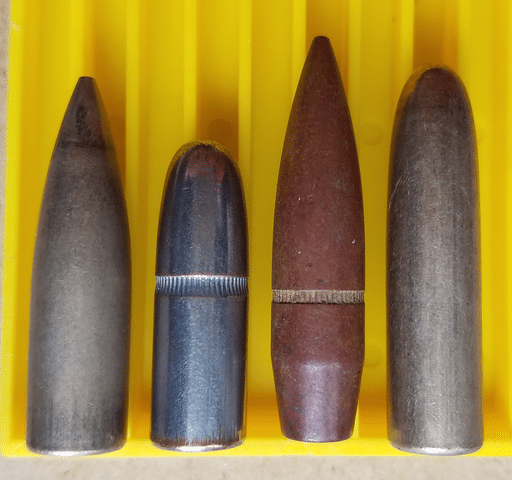
The range of a pistol isn’t a fixed measure. It can change based on several factors. One such factor is the caliber of the pistol. This term refers to the size or diameter of the bullet that the pistol fires. Generally, larger calibers can reach further distances.
Another factor that impacts the range is the speed of the bullet, also known as its muzzle velocity . The faster a bullet leaves the barrel of the pistol, the further it can travel.
Then we have the angle at which the pistol is fired. To get the maximum range, the best angle to shoot is 45 degrees. However, keep in mind that increasing the range may affect the accuracy of your shot.
Last but not least, environmental factors like the wind speed and direction, as well as temperature, can alter the bullet’s trajectory, thus affecting its range.
Bullet Calibers, Credit: Wikimedia/Thewellman
Comparing the range of different pistol models
The range varies across different models of pistols. For example, a .22 caliber pistol, which is one of the smaller types, can typically shoot accurately up to about 50 yards. That’s equivalent to half the length of a football field! On the other hand, a larger pistol, such as a .45 caliber model, has a more considerable range. It can usually shoot accurately up to around 75 yards.
But these figures are not absolutes. They can vary based on the factors we discussed earlier, like the muzzle velocity, shooting angle, and environmental conditions.
Safety measures when shooting a pistol
We mustn’t forget the importance of safety while discussing the shooting range of pistols. It’s a fun and exciting topic, but the safe handling of firearms is crucial.
Firstly, you should only use a pistol in a controlled environment, such as a shooting range, and under adult supervision. Secondly, never point a pistol at anything you don’t intend to shoot. This is a vital rule to remember when handling firearms.
Also, wearing safety gear is mandatory. Eye and ear protection are essential, as shooting can create loud noises and release shell casings that might hurt you.
Glossary
Pistol: A small firearm designed to be held and used with one hand.
Bullet Trajectory: The path that a bullet follows when it is fired from a firearm.
Caliber: The internal diameter of a firearm’s barrel or a bullet’s diameter.
Muzzle Velocity: The speed at which a projectile leaves the muzzle of the firearm.
Shooting Range: A specialized facility, field, or course designed for firearms practice.