Butterflies are one of nature’s most beautiful and intricate creatures. Their wings, particularly, captivate us with their vibrant colors and delicate structure. But have you ever wondered what makes up these stunning wings? Let’s take a closer look to uncover the secrets of butterfly wings.
Understanding butterfly anatomy
Unlike birds and bats, butterflies don’t have bones in their wings. Instead, their wings are made of something called chitin , a lightweight material that’s also found in their exoskeleton . This material is perfect for flying, as it combines strength with flexibility. If you compare it to a bird’s wing, you’ll notice a big difference. Birds have a network of bones, muscles, and feathers that make up their wings, but butterflies rely on a different kind of structure entirely.
But how does a butterfly’s wing go from a bud to its full glory? Inside the chrysalis, the wing grows veins that act like hollow tubes. They fill with hemolymph, a nutrient fluid that expands and straightens the wings into their final form. The veins provide stability while adding little weight, allowing the delicate wings to be both flexible and durable.
Another fascinating aspect of butterfly wings is their scales. These tiny scales overlap like shingles on a roof and are responsible for the brilliant colors we see. They’re not just for show, though. These scales also protect the wing and help in heat regulation. When a butterfly flaps its wings, the movement of these scales creates an iridescent effect that is not only beautiful but also serves as a defense mechanism against predators.
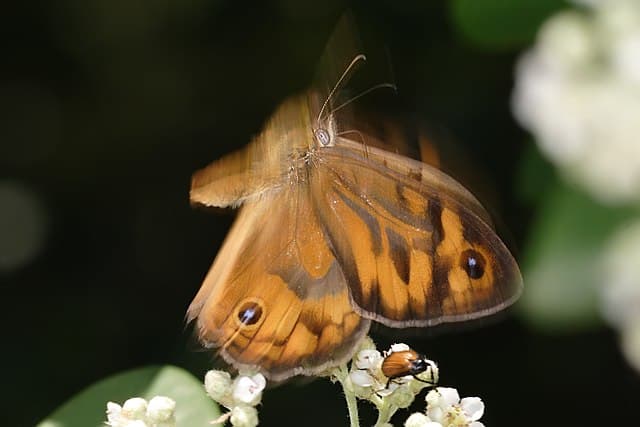
Butterfly in Mid-Flight, Credit: Wikimedia/fir0002
How butterflies use their wings to fly
Even more astonishing is how these wings work in flight. A butterfly flaps its wings about twelve times per second, creating vortexes of air that provide lift and propulsion. Compared to birds or insects like bees, the butterfly’s flight is slow and meandering. Yet the precision and complexity by which they stay aloft on fragile wings is nothing short of masterful.
Butterflies flap their wings in a figure-eight motion , which is quite different from the up-and-down motion we see in birds. This unique movement helps them stay airborne and maneuver through the air with precision. It’s a delicate balance of flapping and gliding that allows them to conserve energy while traveling long distances.
Butterfly wings are not only unique in structure but also in function. For example, some species have wings that can change color based on the temperature or environment. Others use their wings to communicate or ward off predators with eye-like patterns. These wings are a testament to the diversity and adaptability of nature.
In conclusion, butterfly wings are a marvel of nature. They are a blend of art and science, showcasing nature’s ingenuity. Without bones but equipped with scales and chitin, these wings allow butterflies to flutter, soar, and captivate our imaginations.
Butterfly on a Flower, Credit: Wikimedia/flemming christiansen
Glossary
Chitin: A lightweight and flexible material found in the exoskeleton of butterflies, forming the main component of their wings.
Exoskeleton: The external skeleton that supports and protects an insect’s body, unlike internal bones in mammals.
Iridescent: A property of surfaces in which they change color as the angle of view or the angle of illumination changes.
Figure-eight motion: A unique movement pattern used by butterflies when they flap their wings, aiding in their flight.