Ants may look simple at first glance. On deeper inspection, you may find that there are ants that look different in the colony itself. This extends further, and ants of different species and types come in different shapes, sizes, and colors. Different types of ants have different behaviors, and some can even farm. But how do you identify the type of ants you’re dealing with, and what’s the most effective way to get rid of them? In this article, we’ll explore the different types of ants and their behavior, and provide you with practical tips and tricks to eliminate them from your home or yard.
Grab your magnifying glass; now we venture into the tiny realm of ants.
There are over 1,000 species of ants in the US. Some of them are more common than others, but some of them fare well as pesky pests. Here are four ant species that trouble households in the United States.
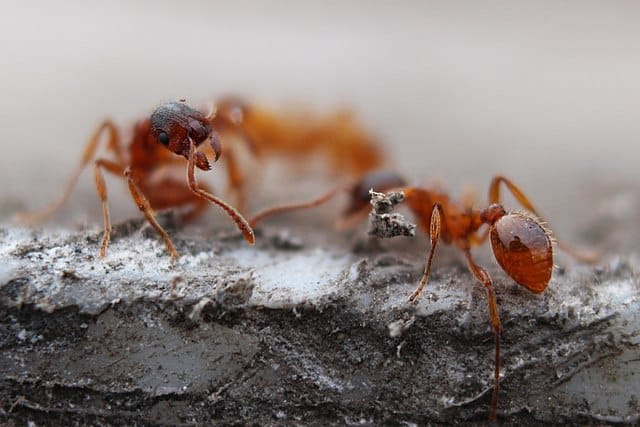
1. Fire Ants
Fire ants got no chill for trespassers, Credit: Wikimedia/Magdalena Smyczek
Scientific name: Solenopsis
Size: 1/8 to 3/8 of an inch (3mm to 9.5mm)
Features: Red with black abdomen, or dark brown and black color with visible stingers. Appear in large colonies.
If you ever stumble upon a nest of fire ants, cue in sad music. With colonies as large as half a million ants, these ants can rain “fire” on your feet. These territorial ants will aggressively attack any intruders, so veer off.
In the United States, two species of fire ants are found—red and black imported fire ants. These ants are native to South America and came to the States on ships. Today, these pests trouble residents of the southern USA. It might seem that these ants are called fire ants because of their red color. However, the name comes from the burning sensation that arises if these ants sting you. This is caused by the effect of a venom called piperidine.
Fun Fact: You might wish heavy rain to flood these ant mounds and hope that the fire ants will go away for good. Hold on! Fire ants band together to form rafts, and float and carry their eggs on them until the water level lowers.
How to get rid of fire ants?
Properly seal and store sweet and fatty foods. Spray a mix of half-water and half-vinegar on the containers to keep fire ants away.
2. Carpenter Ants
A carpenter ant lurking around wooden material, Credit: Wikimedia/Richard Bartz, Munich Makro Freak
Scientific name: Camponotus
Size: 3/8 to ½ inch (9.5mm to 12mm)
Features: Carpenter ants have dark brown, black, or reddish shades. Look for wood shavings and wood dust—a carpenter ant colony might be nearby.
Carpenter ants can make a whole suite out of decaying or moist wood. Their large heads have a pair of strong mandibles which help them chew through wood. Carpenter ants nest and form tunnels, and have parent colonies and spin-off colonies, called satellite colonies. Queens in a colony of carpenter ants can live for almost 25 years! Carpenter ants do not attack unless provoked. Their strong jaws paired with large bodies result in a strong bite that can even break the skin. They go even further and spray copious amounts of formic acid on the wound to add to the pain.
Fun Fact: A species of ant in the Camponotus genus, called Camponotus inflatus, stores nectar and honeydew in its guts, and can swell to the size of a grape. They are commonly called honeypot ants.
How to get rid of carpenter ants?
Follow the ants to their nests, which should be in moist corners of woody structures. These ants have a sweet tooth. Bait them with jam or sugar laced with boric acid , which you can find in any hardware store. You can also use baking soda. Baking soda and boric acid kill these pests.
3. Odorous House Ants
Odorous ants smell like coconut when crushed, Credit: Wikimedia/Jake N.
Scientific name: Tapinoma sessile
Size: 1/16 to 1/8 inch (1.6mm to 3.2mm)
Features: Dark brown to black; smells of coconut if stepped on. Has small nests and lives usually in wall voids, pipes, or other damp areas.
These ants are also called “sugar ants” as they crave sugary food. Apart from nectar and plant sap, they also munch on bugs called aphids . Indoors, odorous house ants satiate their sweet tooth with drops or splashes of sugar syrup and uncovered sources of sugar like fruits or desserts. Odorous house ants are found throughout the US; however, they are more common in northwestern states like Oregon or Washington.
Fun Fact: Odorous house ants shift their nests every three months in response to rain and monsoon.
How to get rid of odorous house ants?
Odorous house ants love sugar. Boric acid mixed with sugar can be used as bait. Usually, odorous ants carry food back to their colony, killing more of these tiny pests.
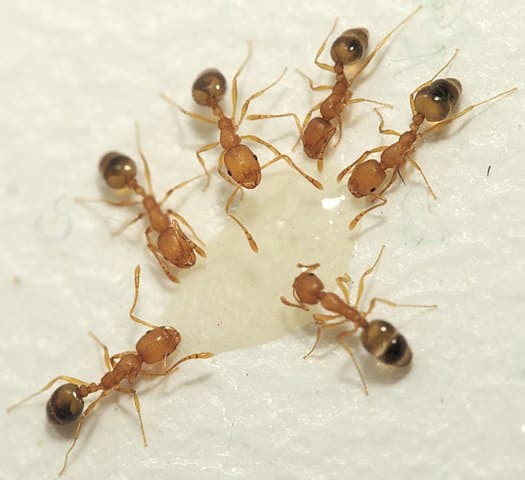
4. Pharaoh Ants
Pharaoh ants can break into secure labs and IV tubes, and can spread disease in hospitals, Credit: Wikimedia/Землеройкин
Scientific name: Monomorium pharaonis
Size: 1/16 to 1/12 inch (1.6mm to 2mm)
Features: Tiny, golden bodies.
Pharaoh ants have links to Africa and are thought to be imported to the States. Pharaoh ants nest indoors in winter. Their favorite spots are inside cabinets, hot tubs, behind curtains, and window panes. Nothing soothes them more than a warm and damp environment. The size and color of these ants help them in being sneaky. While they can vandalize your sweet treats indoors, in hospitals they create serious trouble. They can carry germs for various diseases like Salmonella.
Fun Fact: These ants have been found in tightly secured labs, and even inside IV tubes.
How to get rid of pharaoh ants?
This time, no baits or tricks can help you to bid adieu to these pests. The best you can do is deep clean kitchens and rooms, and seal cracks before winter arrives. In case of an infestation, call a pest exterminator.
These were some of the ants found in the States. Now, let’s move on to some of the wackier to outright weird types of ants, which probably won’t bother you much.
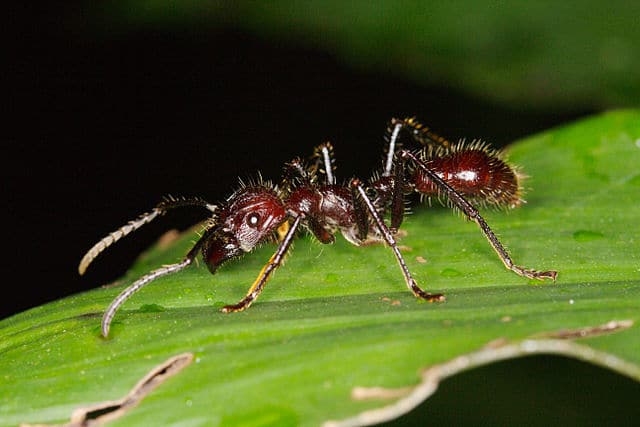
5. Strike like a bullet: Bullet Ants
Bullet ants score a 4 out of 4 on the Schmidt Pain Index. Their sting feels like a bullet shot, Credit: Wikimedia/ Graham Wise
Scientific name: Paraponera clavata
Size: 0.7 to 1.2 inch (18mm to 30mm)
Features: Reddish black. Has large mandibles and a large, visible stinger.
Bullet ants terrorize the rainforests of Central America and South America. They don’t get their flashy name for no reason. Their sting hurts, and feels like a bullet has pierced your skin. Poneratoxin in the sing venom attacks the nervous system and brings about pain. The skin at the site of the sting swells, and the person may shake and jerk due to the pain. Cold compress and painkillers can help reduce the pain. Bullet ants are also called “24-hour ants” since the pain subsides after a day. Bullet ants feed on nectar and small insects.
Fun Fact: Larvae of glasswing butterflies were comfort food for these ants until the butterflies evolved to produce larvae that taste bad.
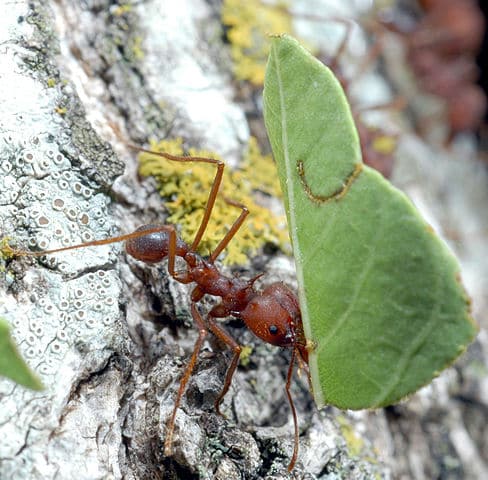
6. We’re something of a farmer: Leaf-cutter ants
A leafcutter ant foraging leaves to farm fungi. Note the spines on its back, Credit: Wikimedia/Clinton & Charles Robertson
Scientific name: Atta cephalotes
Size: 1/16 to ½ inch (1.6mm to 12.7mm)
Features: Pale brown. Four pair of spines on the back gives a thorny appearance.
Leaf-cutter ants have been cutting leaves with their sharp mandibles for over 50 million years. However, the leaves are not for the ants to enjoy. The ants use the leaves as a source of nutrition for a fungus called Lepiotaceae. The ants cannot digest these leaves, but the fungi can. Once the fungi digest the leaves, the ant can feast on it to meet their nutrition needs. Leaf-cutter ants have no sting, but their bite covers up the lack thereof. These ants are found in very few localities in the southern USA. Most of these ants live in dense forests of South and Central America.
Fun Fact: These specific fungi are not found outside ant nests in nature, and have evolved to a point at which it is completely different from the wild-type variants.
Readability: 74.1
Grade Score: 5.7
Glossary
Mandibles: Little crushing organs present in front of the mouth of ants and other insects
Formic Acid: A liquid present in the stings of many insects. This acid damages skin and tissues
Honeydew: A sugary liquid left behind by bugs called aphids
Boric Acid: A component of detergents and soaps. Boric acid kills insects if ingested
Aphids: Also known as “ant cows,” aphids are bugs that eat plant sap and expel honeydew for ants to collect afterward
Painkillers: Medicine that can reduce pain by blocking nerves that send pain signals to the brain
Nectar: Sweet substance found in flowers that attracts insects. Many insects use nectar as a staple food