A lot of the litter humans create ends up in the ocean; however, understanding where it comes from and where it ends up has been difficult since it requires a significant amount of effort to keep track of the litter as it spreads throughout the water. Now, a team of European scientists has found a way to track litter and debris effectively – by using satellites.
Earth monitoring satellites have been around for some time, but so far, none have been able to track litter as it moves around the planet’s oceans. Tracking debris is difficult because each piece is relatively small and doesn’t appear well on satellite images. However, if enough of those images were strung together, slight changes could show researchers where the litter is going.
So, the research team strung together 300,000 images from the European Copernicus Sentinel-2 satellite. The satellite collected an image every three days over six years. To analyze all those images, the researchers used a supercomputer and an advanced type of computer algorithm that allowed them to search for interesting things – in this case plastic debris.
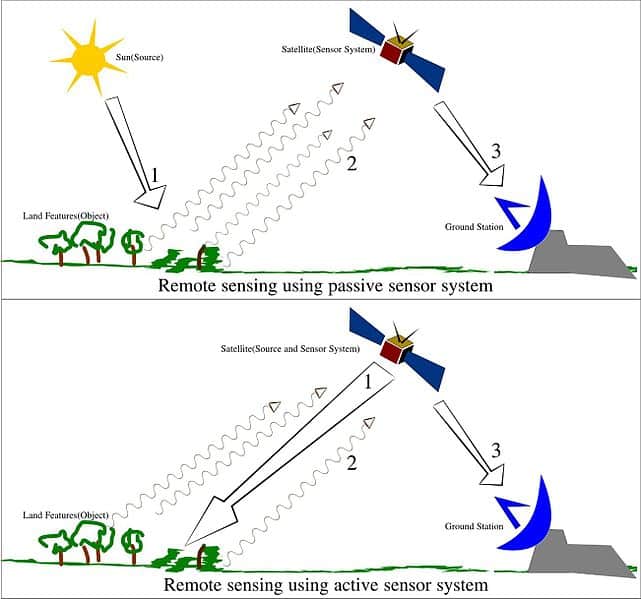
Illustration of Remote Sensing, Credit: Wikimedia/Arkarjun
Each image could make out an object about 10 meters in size – much larger than a typical piece of litter but small enough to show patches of litter. Those patches of litter, known scientifically as ‘windrows’, did show up in the images. Some were several kilometers long and primarily made of plastic, which the satellites’ sensors were particularly tuned to. Overall, the researchers found an amount of litter in the Mediterrean Sea that would cover 7,500 football fields.
Where does litter in the ocean come from?
But more importantly, they discovered that litter’s potential sources and resting locations. They could track litter from its source – typically a river – to where it wound up stuck in the sea. Areas of particular concern for that corner of the Mediterranean were the Tiber River, which runs through Rome, and the Suez Canal, which runs through part of Egypt.
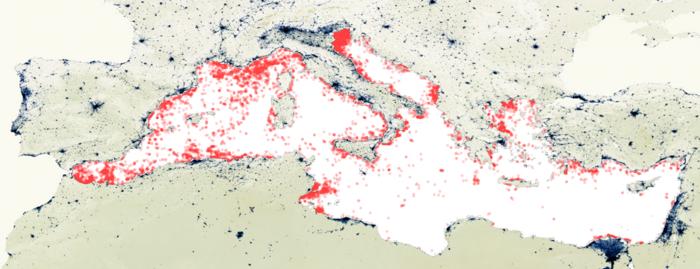
Map of the Mediterrean Sea showing accumulation of litter (red dots) and industrial / urban zones (blue dots).Credit - Manuel Arias / Andrés Cózar
The researchers also found that litter from those point sources only temporarily ended up in the sea. After a few months, it migrated back onto the beaches of Africa and Europe after only having made it about 15 kilometers out to sea on the river currents. That is in contrast to the debris that collects farther out to see, which seems to have been created by ships such as cargo ships or cruise liners that spend their time further out to sea. The litter that collects from these ocean-based sources collects in different parts of the sea, and stays there permanently, never being pushed back to land.
Another factor in understanding where litter came from seemed to be population density. Much of the coast of North Africa is barren desert, and not much of the total amount of debris in the Mediterrean came from that area. By contrast, large cities like Rome and Nice, which sometimes receive large amounts of rainfall, seem to be larger sources of litter.
How do we stop it?
Understanding where the litter came from is only the first part of the battle though. The researchers hope their findings can help local authorities combat litter at its source. Also, it could potentially be useful to people looking to clean up the litter that does make it out to sea.
What’s more, by changing the sensor on the satellite, and the computer program they used, the researchers think they could track other interesting things on the sea – such as oil spills or lost shipping containers. For now, that is still speculation, but it goes to show how useful remote sensing from a satellite can be.