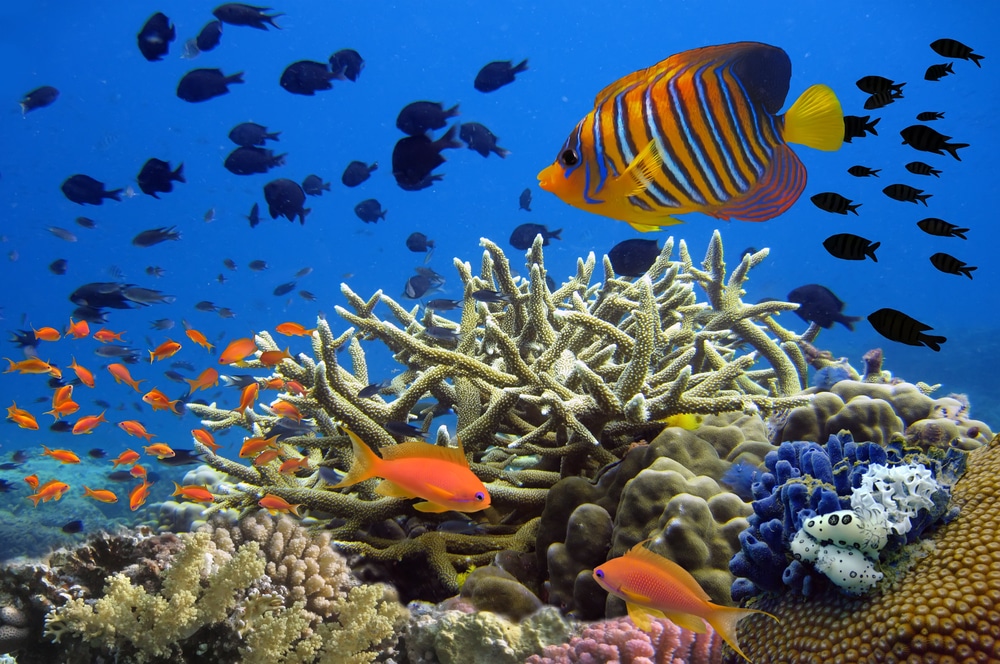
The depths of the ocean are filled with peculiar and curious creatures. One of them is the black dragonfish. Long, slender, and similar in appearance to an eel, these creatures are famous for many reasons. So, let’s dive into the mysterious depths of the oceans to learn more about this magnificent being.
Credit: Depositphotos/Vlad61
The twin skills of bioluminescence and camouflage
Wouldn’t it be cool to be able to produce your own light and glow in the dark? Well, the black dragonfish does have this superpower. Black dragonfish can produce a blue light which helps them catch prey. They use specialized light-emitting organs, also called photophores, to create bioluminescence using an enzyme called coelenterazine. This special enzyme emits light. But why does it emit only blue light; why not green or pink? To understand that, it’s important to understand the interaction between light and water.
It is said that water is over 800 times denser than air, which makes it difficult for light waves to pass through it. However, certain wavelengths of light, such as blue light, can penetrate the dense water and shine much deeper and brighter. This is why marine animals emit blue light. However, other colors, such as red light, are quickly absorbed by the water and can’t penetrate deep into the ocean. Since red light is quite dim, animals that are prey for other beings prefer to emit red light. This effectively conceals their presence from predators . Most predator animals are unable to see the red light, which is another reason why prey animals prefer to use it. However, black dragonfish have evolved to detect and see red light. They have large eyes that have a special pigment that improves their ability to see red colors, making black dragonfish one of the very few marine animals able to detect red light!
One cool fact: Black dragonfish have another special set of photophores present just below their eyes that produce red light. Since black dragonfish are the only animals able to both detect and produce red light, scientists believe that they use this power to communicate with each other! Kinda like how you may communicate with your best friend using a secret language only you two know.
How to hide your big, scary teeth to catch prey
If a small fish in the ocean saw an animal with deadly, jagged, and needle-like teeth, the first thing it would do was swim away. But what if these teeth were invisible to the poor fish? It would probably think that the sea animal was harmless and might go up close to it. That is when the predator would reveal its true colors (and teeth!) and gobble up the fish as food. This is how camouflage works.
The black dragonfish, too, uses the power of concealed teeth to catch prey. The teeth of the black dragonfish have a very fine microscopic structure. Due to this structure, any light in the ocean, and even the light from the black dragonfish’s own bioluminescence, doesn’t reflect off its teeth, which efficiently conceals them. Additionally, the black dragonfish are pitch black in color, which helps them blend well with the dark abyss of the deep sea.
Venomous and dangerous
Black dragonfish are carnivorous. They eat other small fishes, fish eggs, shrimp, and small marine animals; although they will not pass up a meal of plankton or algae.
Black dragonfish are also known for their ability to emit venom through their skin. The venom not only causes the death of other animals in the ocean, but is also dangerous for us humans. Fortunately for us, they only live in extreme depths of the ocean.
It is pretty clear that black dragonfish are quite dangerous and deadly. But this deadliness is exactly what makes them interesting and unique!
Flesch Kincaid Reading Ease: 66.9
Flesch Kincaid Grade Level: 8
Glossary
Photophores: Organs consisting of light-emitting cells
Bioluminescence: The ability of certain animals to create and emit their own light
Coelenterazine: An enzyme involved in bioluminescent reactions