From Pangea and Gondwana to Africa and Australia—how and why does the world keep changing?
Are continents moving?
If you have ever looked at a world map really carefully, you may have noticed that Africa and South America look like pieces of a jigsaw puzzle. The continents seem to fit together. Why is this the case?
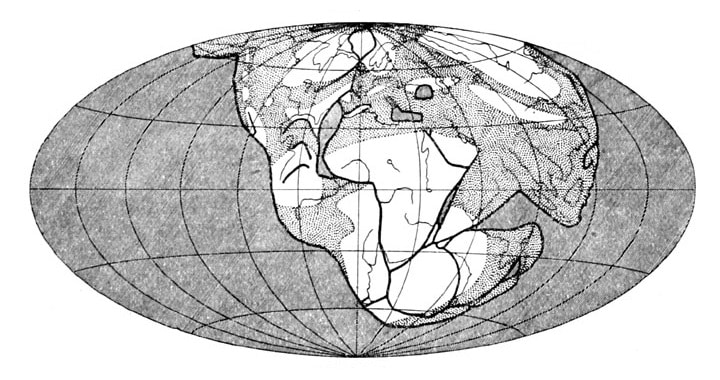
The answer to this question was provided by Alfred Wegener in 1912. He found similar fossils on the coasts of Africa and South America and noticed that the continents’ coastlines fitted into each other like puzzle pieces. To answer this question, Wegener proposed the theory of continental drift. According to this theory, continents moved relative to one another, seeming like they drifted across the ocean. Wegener was also the first to propose the existence of Pangea, a supercontinent that had all the land masses we know today put together. The theory didn’t receive much appreciation in the scientific community until the sixties. Using advanced technology, scientists formed a new theory—the theory of plate tectonics.
What is the theory of plate tectonics?
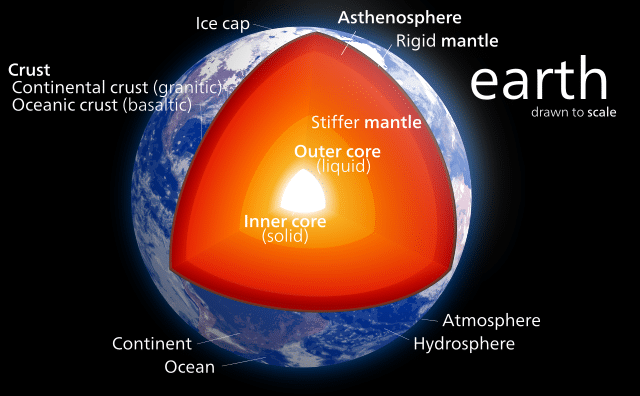
According to the theory of plate tectonics, the crust of Earth is broken into several pieces, like a cracked eggshell covering a boiled egg. All land is just a part of the uppermost layer of the Earth, known as the crust. If the Earth is an apple, the crust is just as thin as the apple’s skin. Below this skin exists a layer known as the asthenosphere . The asthenosphere is about 10% liquid magma, the rest being heated rock with the consistency of Play-Doh, which is heated up by the hot, solid inner core. According to this theory, the plates drift and move on the surface of the Earth, and so landmasses drift—South America and Africa are like giant separated jigsaw pieces. The plates float on the said asthenosphere. The question arises, what humongous force makes chunks of land, thousands of square miles across, move from one place to another?
The crust and the asthenosphere are the two outermost layers of the Earth, Credit: Wikimedia/Kelvinsong
Why do tectonic plates move?
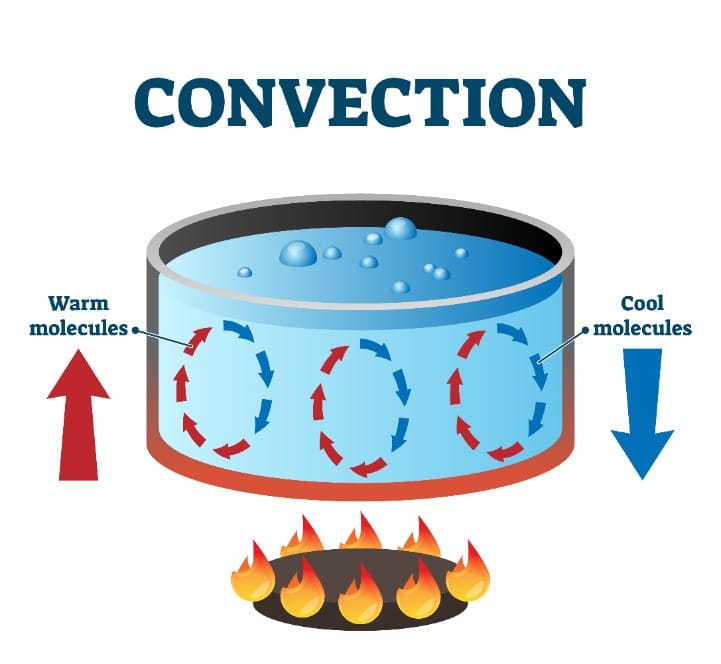
Tectonic plates move due to a phenomenon called convection . If you have noticed boiling water in a pot, you may find it gurgling. The top of the pot of water gets very hot, but the bottom stays relatively cool. This is also due to convection. The gurgling motion occurs because the warmer water is lighter than cold water and rises from the bottom of the pan to the top, while colder water at the top sinks.
The movement of warm and cold water molecules in a pot of heated water, Credit: 123rf.com/normaals
The mantle is a liquid, and it has convection currents too! The core is like a stove, slowly heating the mantle.
To understand why tectonic plates move, you can make a small observation yourself. With help from your parents, add pieces of leaves to boiling water. You will find the leaves start moving around on the water’s surface. The tectonic plates are like those leaves, while the boiling water can be considered as the mantle and asthenosphere. The movement of the mantle through convection currents push these tectonic plates around. There are two kinds of plates: oceanic and continental. Oceanic plates are made of heavy, dense rocks, and continental plates are much lighter.
Some of the main plates that make up the Earth’s crust, Credit: Wikimedia/Eric Gaba (Sting - fr:Sting)
Alfred Wegener’s sketch of Pangea, Credit: Wikimedia/Von Alfred Wegener erstellte Karte
What is a plate boundary?
The region where two plates meet is called a plate boundary. There are three types of plate boundaries:
Plates move towards one another, at a convergent plate boundary
Plates move apart from one another, at a divergent plate boundary.
At a transform plate boundary, two plates slide over one another.
How do plate tectonics affect the geographical features of a place?
Most tectonic action is reserved for the plate boundaries. Earthquakes, volcanoes, and mountains develop when two plates move relative to one another.
Mountains
Mountains form at convergent boundaries between continental plates. Continental plates are the same weight, so when they push against each other, neither gives! Instead, both rise. The Appalachian Mountains in the United States formed 300 million years back when North American and African plates collided. The most spectacular example is the Himalayas, the tallest mountain range in the world. The Himalayas are caused by the Indian plate and the Eurasian plate pushing against each other.
Mountains forming at a continental–continental plate boundary, Credit: Wikimedia/domdomegg
Earthquakes
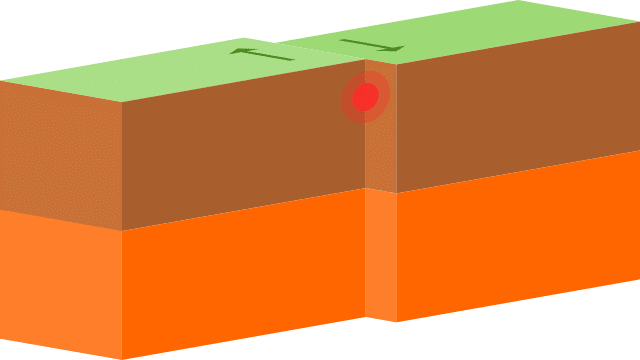
Plates usually move incredibly slowly—slower even than your fingernails grow. Some move up to four inches (ten centimeters) a year, but most are much slower than this. Even though they move so slowly, it’s important to remember that they are massive! A huge amount of pressure can build up, and then suddenly release. When plates move parallelly, they generate friction and pressure, which releases in the form of an earthquake. Earthquakes can occur at non-continental plate boundaries too, but those are less common.
Two tectonic plates moving parallel to each other, Credit: Wikimedia/domdomegg
One example is the famous San Andreas fault in California, between the Pacific plate and North American plate. It has been the cause of many earthquakes, though seismologists have gotten better at predicting when earthquakes can take place.
Volcanoes
Volcanoes form when a continental plate coming into contact with an oceanic plate ends up getting pushed down. This is because the oceanic plate is denser. When one plate gets pushed beneath another, magma bubbles to the surface, forming a volcano! These can form both between oceanic–oceanic plate boundaries and oceanic–continental plate boundaries.
A volcano forming due to one plate being pushed beneath another, Credit: Wikimedia/domdomegg
Volcanoes can also form at divergent plate boundaries. When plates move away from each other, the mantle has space to spread upwards. The bubbling magma forms new volcanoes.
Ring of Fire
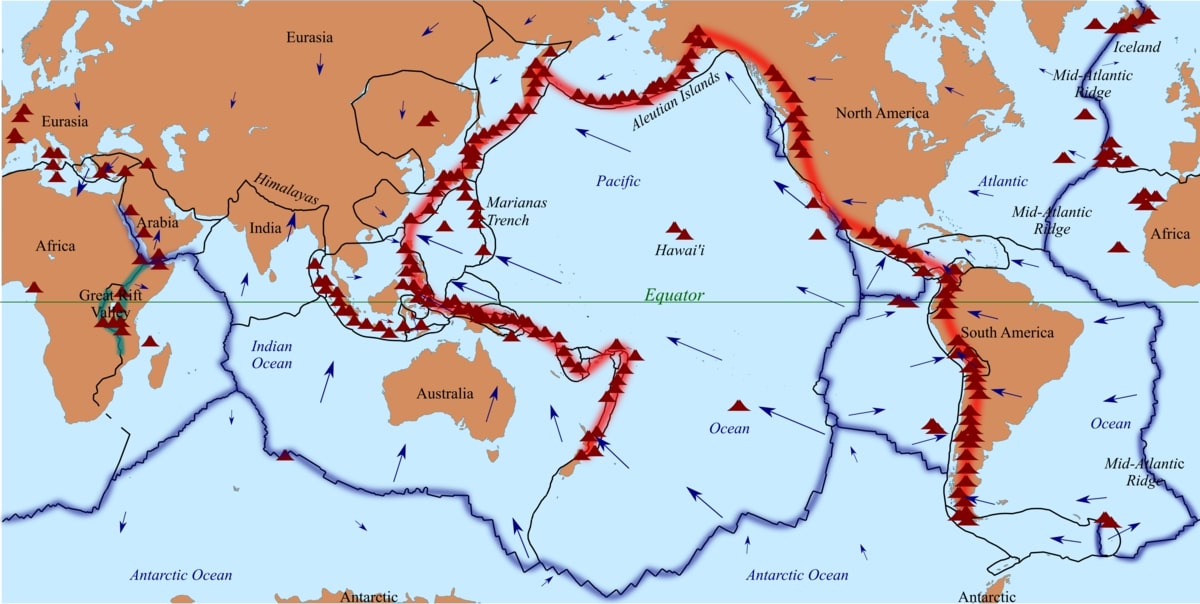
The Ring of Fire is a chain of volcanoes that line the Pacific plate, which is the largest tectonic plate. Different plates around the Pacific plate come together in collisions, or move apart, giving rise to chains of active volcanoes. Usually, active volcanoes bring a partner— earthquakes. Areas with active volcanoes are also the areas which are most prone to earthquakes.
The Ring of Fire. Notice how this chain of volcanoes grazes major tectonic plates. Credit: Wikimedia Commons/ Astroskiandhike
Plate tectonics can explain so much of the world around us, from mountains to volcanoes and earthquakes! Are any geological features in your region formed due to the movement of tectonic plates?
Glossary
Asthenosphere: The hot liquid mantle beneath the crust
Convection: The movement of hot molecules through a liquid medium when being heated
Convergent Plate Boundary: A boundary where two plates move towards each other
Divergent Plate Boundary: A boundary where two plates move away from each other
Seismologist: A scientist that studies the movement of the tectonic plates
Tectonic Plate: Sections of the Earth’s crust, that can be continental or oceanic
Yamini's (he/they) interests lie in environmental education, science communication and trying to build a better world. When not languishing in front of his laptop, they can be found outside, poking at any insect, bird or plant. They love making science accessible, especially to those who aren't encouraged to pursue it. Yamini hopes that the young women who read Smore love learning from their articles and get just a little bit more excited about science!