There are over a million different species on Earth. Humans, however, are unique. But what about all the other planets out there? Could there be another world with creatures like us, wondering about their uniqueness, too? Or are we truly alone? The answer may surprise you.
Do aliens exist? What would they look like?
Let’s first consider Earth’s neighbourhood. Our solar system has eight planets. Out of these, four have rocky surfaces. But having a solid surface is not enough to support life. For astrobiological life to exist, a planet must be able to hold liquid water on its surface. And for this to happen, a planet must have a non-toxic atmosphere and be just the right distance from the sun. Unfortunately, other than Earth, no such planet in our solar system exists.
But that does not mean that the rest of our solar system is barren. Most of the life on Earth may not be able to exist in sub-zero temperatures for long, but hundreds and thousands of bacteria have survived centuries of being frozen in glaciers, and are now being released into the ocean as the ice melts. This endurance, along with their basic biology, has led astronomers to believe that aliens are more likely to be simple organisms like bacteria rather than complex creatures like humans.
If this is true, there are many places within our very own solar system that could host life. Jupiter’s moon, Europa, is one such place. While Europa’s surface is covered with an icy crust which is regularly blasted with lethal radiation from its planet, data gathered from NASA’s spacecraft Galileo has led scientists to believe that there may be vast oceans of water below. These oceans may potentially be carrying important chemicals and nutrients required for Earth-like bacteria to exist.
An image of Europa captured by NASA’s Juno Spacecraft during its flyby in 2022, Credit: NASA/JPL-Caltech/SwRI/MSSS/Kevin M. Gi BY 3.0
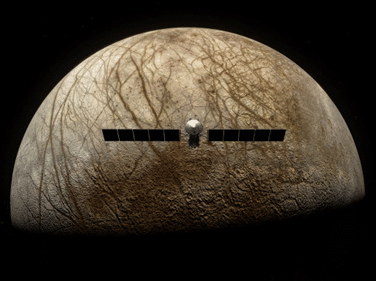
But as hopeful as this theory is, it comes with its own set of complications. Single-celled life is a less intelligent form of life. They would not have enough awareness to reach out to us. They also would not produce large-scale heat signatures like human industries do, and this would make it harder for our probes to detect them. This is why on October 10, 2024, NASA is sending Europa Clipper, its largest planetary mission spacecraft to date, to determine whether there are places below Europa’s surface that can or do support life.
An imagined image of Europa Clipper flying over Europa in search of life
Could there be intelligent life out there?
Bacteria-like aliens are one thing, but could there be human-like life on an Earth-like planet out there? We know that certain conditions need to be met for life to exist on a planet. But that does not mean that any planet with an Earth-like weather, atmosphere and geology could host human-like life.
Scientists still are not sure what caused life on Earth in the first place. Is it just the way a planet evolves? Or was it the collision that happened in Earth’s early days with a small planet called Theia, that brought chemicals necessary for life to the surface of the planet and made life possible? Maybe it was all the water that was brought to Earth by asteroids that collided into it during a crucial early time. It may be all these reasons or none of them. The best astronomers can do is search for as many habitable planets as they can, before looking for signs of life on them.
But experts like Sarah Johnson, an American biologist, geochemist and astronomer, believe that limiting our search to Earth-like parameters has more to do with our biases than actual science, and we may have better luck if we stopped searching for extraterrestrial creatures that look familiar. In fact, alien life could be so different from life on Earth, that maybe we would not even recognise it if we saw it. This is why LAB, a NASA funded initiative, is doing a different type of search. Instead of looking for biosignatures similar to Earth-like life, it is looking for complex structures that may not have happened naturally.
Hence, even though astronomers have no definite proof of extraterrestrial life, they are still hopeful that somewhere out there, hidden from us, a species completely different from us, or exactly like us, exists. And maybe, someday, we will finally get the chance to meet them.